
Custom Metal Enclosures and Brackets for Industrial Equipment: How to Choose a China Manufacturer
 Short answer: The manufacturers that handle custom metal enclosures and brackets for industrial equipment well are the ones that can do both thin-gauge precision work and heavy-gauge structural work in house — typically a factory running a wide press range, its own tooling, and finishing under one roof. Ask for the press tonnage spread, the largest part envelope, whether the factory builds the die internally, and which secondary processes stay on site. Suppliers who can answer all four with specifics can carry an industrial programme; those who answer with a price alone usually cannot.
Industrial equipment is an awkward category to buy metal parts for. An electrical cabinet, a control box, a machine guard and a mounting bracket may all sit on the same bill of materials, yet they come from different manufacturing logics. One needs flatness and powder-coat adhesion. Another needs weld strength and structural rigidity. A third needs thousands of identical pieces at a low unit cost. Choosing custom metal enclosures and brackets therefore starts with sorting your own parts, not with comparing factory lists.
Why industrial equipment is harder to source than consumer hardware
Consumer products usually settle into one process family and stay there. Industrial equipment does not. Three characteristics drive that.
- Part sizes vary widely. A 60 mm sensor housing and a 1,400 mm cabinet frame can belong to the same machine. A factory that only runs small presses cannot bend the frame, and a shop built for heavy plate rarely holds tolerance on the small housing.
- Volume per part number is uneven. A machine builder may need 40 units of a frame and 20,000 units of a bracket. The frame suits laser cutting and bending; the bracket suits a progressive die. Buying both from one supplier only works if that supplier runs both routes.
- The service environment sets the finish requirement. Washdown areas, outdoor installations and high-vibration mounts each demand a different material and coating combination, and the finishing decision usually lands with the same supplier who formed the part.
Custom metal enclosures and brackets are two different manufacturing problems
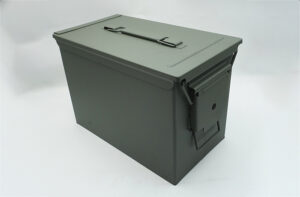
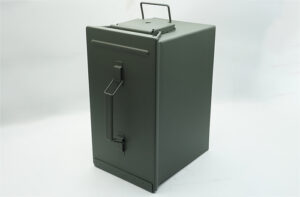
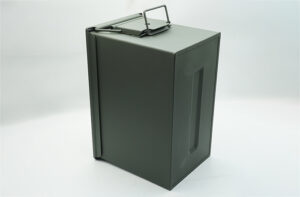
This distinction matters more than any supplier ranking, because the two part families fail in different ways. Custom metal enclosures and brackets appear on the same quotation, yet each family follows a different manufacturing logic.
Enclosures: forming route decides everything
| Enclosure type | Typical forming route | Best volume band | What to watch |
|---|---|---|---|
| Flat-sided cabinet, panel, door | Laser cut, press-brake formed, welded | 1 to 5,000 | Weld distortion on tall frames; flatness after coating |
| Control box, terminal housing | Press brake forming or blank-and-draw | 500 to 50,000 | Corner joint consistency; gasket groove tolerance |
| Deep drawn shell, cover, can | Deep drawing with progressive or transfer tooling | 5,000 to 500,000+ | Draw radius and material grade decide whether it forms at all |
| Sealed or washdown enclosure | Formed shell plus gasket groove and welded seams | Any, but tooling-driven | Leak path at seams; coating inside corners |
The single most common enclosure mistake is to specify a laser-cut and welded box for a volume where a drawn shell would cost less, or the reverse. Welded fabrication needs no tooling, so it wins at low volume and loses badly once the annual quantity reaches five figures. A drawn shell spreads tooling cost across every part, but only if the geometry allows drawing in the first place.
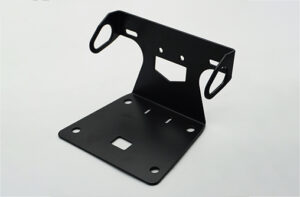
Brackets: cut-and-bend versus stamped
| Bracket type | Route | Break-even signal |
|---|---|---|
| One-off or prototype bracket | Laser cut plus press brake | No tooling; cost is almost all machine time |
| Low volume, high variety | Laser cut, formed, deburred | Design changes are free; setup dominates cost |
| Single part number, repeating | Progressive die stamping | Die amortises, unit cost falls sharply |
| Heavy structural bracket | Plate cutting plus welding or heavy press | Material grade and weld procedure matter more than tonnage |
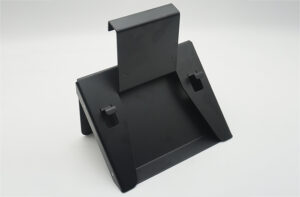
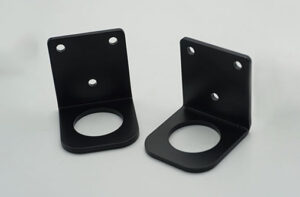
For brackets, the question is rarely “can this factory make it” and almost always “which route is cheaper at my annual volume“. A factory that can quote both routes honestly is more useful than one that only sells tooling.
The capability checklist for industrial enclosure and bracket suppliers
Rank suppliers on evidence rather than claims. Each item below asks for a number or a document, which is what makes it useful.
| Capability item | Why it decides the award | What a strong answer looks like |
|---|---|---|
| Press range and count | Decides which of your parts can be formed in house | A stated span such as 80 to 400 tons across 40 stamping presses, rather than a single maximum |
| Largest part envelope | Decides whether frames and large cabinets are possible | Maximum bed size and maximum formed length in millimetres |
| Tooling ownership | Decides who controls your lead time and your data | Dies designed and maintained internally, or a named partner shop with stated capacity |
| In-house secondary processes | Decides how many parties can break quality | Welding, deburring and surface treatment all on site, with the treatments named |
| Inspection equipment | Decides whether claims can be proved | Coordinate measuring machine, image measuring instrument, harness or hardness testing |
| Material range | Decides whether the service environment is covered | Plain, galvanised, stainless and aluminium grades actually held in stock |
A supplier who cannot state the largest part envelope, or who subcontracts all finishing, will still quote your enclosure. The quote is not the problem; the recovery time when a coating batch fails is.
Match the process route to the part before you compare price
Route selection usually narrows the supplier shortlist faster than any questionnaire.
| Your part | Sensible primary route | Secondary processes to confirm |
|---|---|---|
| Control cabinet, 800 mm and above | Laser cut, formed, welded frame | Weld fixtures, stress relief, powder coating line |
| Small housing, under 100 mm | Progressive die stamping or deep drawing | Deburring, plating or passivation, tumble finish |
| Mounting bracket, one part number | Progressive die once volume justifies | Deburring, coating, batch inspection |
| Mixed bracket set, low volume | Laser cut and press brake | Deburring, batch traceability |
| Structural support, thick plate | Plate cutting, forming, welded assembly | Weld procedure, NDT if specified, heavy coating |
Once you know the route, you also know the tonnage band, the tooling question and the finishing question — which is exactly the information a capable factory needs to quote accurately instead of guessing.
What drives the cost of custom metal enclosures and brackets
Four cost blocks dominate, and only one of them responds to negotiation.
| Cost block | Driver | How buyers reduce it |
|---|---|---|
| Tooling | Part complexity, number of stations, material of the die | Freeze the design before cutting steel; reuse a die family across similar parts |
| Material | Grade, thickness, nesting efficiency | Right-size the blank; avoid over-specifying stainless where coated steel works |
| Machine time | Forming route, part count, setup frequency | Consolidate part numbers; move repeating brackets onto a die |
| Finishing and handling | Coating type, masking, packing for transit | Design for even coating; agree packing before the first shipment |
Buyers often push hardest on the unit price, which is largely material and machine time. The bigger saving usually sits in tooling and setup, where a design decision — not a negotiation — removes cost permanently. That is why the design-for-manufacturability review matters more than the third round of quotation.
Verifying a supplier before you commit an industrial programme
Five checks separate a factory from a broker, and all five are cheap to run.
- Ask for the press list with tonnage and count. A real factory can produce it in minutes. Vague answers about “advanced equipment” signal the same thing.
- Ask who owns the die and who maintains it. If an unnamed third party builds the die, your recovery path when it wears is a queue you do not control.
- Request a first article inspection report from a comparable part. Not a sample photo — a dimensional report with measured values against your drawing.
- Confirm which processes are on site. Welding, deburring and surface treatment top the list of processes that suppliers subcontract, and each adds a handover where quality can slip.
- Test the engineering response. Send a drawing with one deliberate tolerance question. A supplier who answers it technically before quoting is the one worth shortlisting.
Frequently Asked Questions
Can one manufacturer supply both enclosures and brackets?
Yes, and for industrial equipment it is often the better arrangement. Enclosures usually need forming and welding while brackets need stamping, so a factory running both a press range and press brakes can cover the whole bill of materials. The practical test is whether both capabilities sit in house or whether the supplier subcontracts one of them.
What is the largest enclosure a Chinese fabricator can typically produce?
It depends far more on the press brake and welding table than on the press. Before quoting, ask for the maximum formed length and maximum sheet size. For large cabinets, the limiting factor is usually welding distortion control rather than cutting or bending capacity.
Do I need stamping tooling for industrial brackets?
Only when one part number repeats at volume. Below roughly a few thousand pieces a year, laser cutting plus press brake forming normally costs less, because it carries no tooling cost and absorbs design changes for free. Above that, a die starts to reduce unit cost enough to pay for itself.
How do I check that a supplier actually makes its own parts?
Ask three questions in one email: the press tonnage spread and count, the largest part envelope, and which secondary processes stay on site. A factory answers with numbers. A trading company answers with adjectives, or forwards the question and returns with a price.
Which finish should industrial enclosures use?
Match the finish to the service environment rather than to appearance. Indoor control cabinets commonly use powder coating over cold-rolled steel. Outdoor or washdown installations usually need galvanised or stainless substrate, with passivation for stainless. Confirm the coating thickness and the masking plan before production.
About the manufacturer
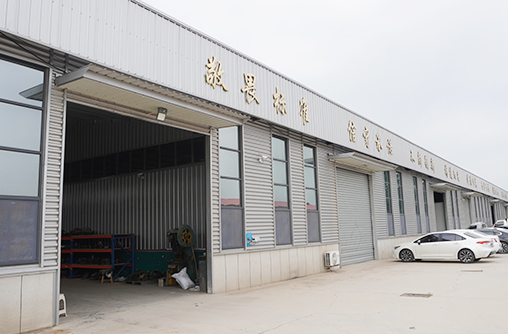 Cangzhou Weizhi has built custom metal parts since 1999, and its factory in Nanpi County, Cangzhou, Hebei Province holds ISO 9001:2015 certification — China’s hardware manufacturing heartland, about 90 minutes from Beijing and Tianjin. Our 120-strong team includes 19 engineers dedicated to custom project development, and we have produced more than 70,000 custom metal part numbers for over 3,000 enterprises in more than 100 countries.
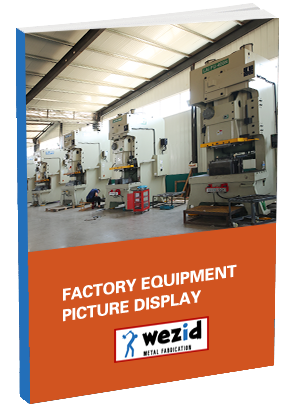
For industrial equipment specifically, we keep the full chain in house: 40 stamping presses spanning 80 to 400 tons, 6 kW laser cutting, CNC machining, welding, deep drawing and surface treatment. That spread lets us run a welded cabinet frame and a progressive-die bracket in the same programme, at a daily capacity of 5,000 pieces and roughly 150,000 pieces a month, with a firm delivery date on every order.
Design questions before you commit to tooling? Our engineers review your drawings and return manufacturability feedback — free of charge
|
Enclosures and Brackets — One Factory, Both Routes ✅ Free DFM review · 2-hour response · Samples ship within 72 hours
Upload your drawing and annual volume — get a process route recommendation and an itemized quote |
📩 Response within 2 hours · DFM feedback and itemized quote within 24 hours
|
Related Posts
-
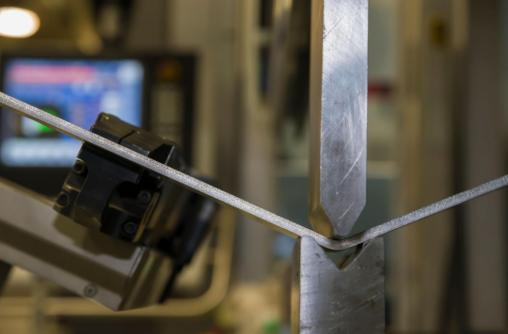
Press Brake Springback: Why Bends Overshoot and How Factories Compensate
Press brake springback is elastic recovery: when the brake releases, the part straightens a few ...
-
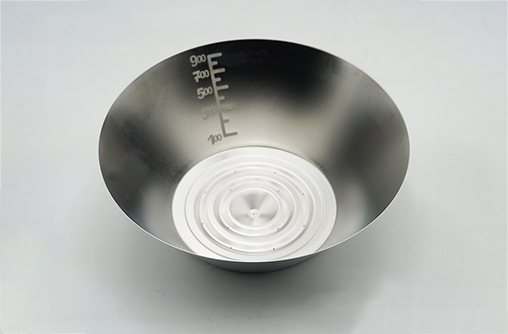
Deep Drawing Sheet Metal: Draw Ratios, Limits & Multi-Hit Setup
Deep drawing sheet metal is a forming operation: a punch pulls a flat blank into a cup or pan sh ...
-

Sheet Metal Gauge Chart: Thickness, Strength & Cost by Gauge
This sheet metal gauge chart is the reference our press engineers use before quoting. Gauge is a ...