

Press Brake Springback: Why Bends Overshoot and How Factories Compensate
Press brake springback is elastic recovery: when the brake releases, the part straightens a few degrees because the outer fibers of the bend were only elastically deformed. The practical consequence — the part ends up more open than the die angle, so the press operator must bend past the target. In mild steel at typical air-bending settings, expect 2–8° of recovery; stainless and high-strength steels give more; thin sheet relative to its inside radius gives the most.
Springback is not a defect and it cannot be eliminated in air bending — it is a physics constant of the process that every competent brake shop compensates for, part by part, material by material. Here is what drives it and how we manage it on the brake line.
Understand what causes press brake springback
When a sheet bends, the outer fibers stretch and the inner fibers compress. On release:
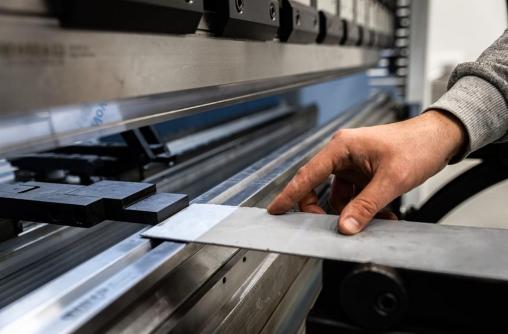 The elastic zone (outer surface) springs back immediately — that is the overshoot.
- The plastic zone (deeper in the section) holds the new shape.
The more of the cross-section that stays elastic, the more it springs back. That is why the three drivers are:
- Yield strength — stronger material (stainless, HSLA, spring steel) springs back more than mild steel at the same geometry.
- The t/R ratio — sheet thickness over inside bend radius. A 1.2 mm sheet bent to a 1.2 mm radius holds shape; the same sheet at a 4 mm radius springs back visibly more.
- Tooling pressure — the deeper the punch travels (the closer to bottoming), the less elastic recovery remains.
Material property data for the strength side of this equation is tabulated by Engineering ToolBox, and the material choice itself is the first lever — our material selection guide covers it.
Read typical springback values by material
These are envelopes, not predictions: the exact value depends on the t/R ratio, the tooling, and the batch of steel. That is why a brake setup starts with test bends — three sacrificial bends on the same stock, angles measured, offset locked in before the real parts run.
See how the factory compensates
Three techniques, in ascending order of control:
- Air bending with angle offset. The operator programs the press to stop at a die angle sharper than the target, so the release lands on spec. This is the daily workhorse: fast, tool-light, good for ±1–2° result.
- Bottoming. The punch pushes the sheet fully into the die; the part takes the die’s angle directly, leaving only a small residual. Tighter than air bending, slower, more tool wear.
- Coining. The punch forces the sheet to the exact die geometry, eliminating springback almost entirely. The cost: high tonnage, tool marks on the bend line, and tooling sized for the exact radius. Reserved for tight-angle, repeat features.
The choice follows the tolerance: a general-tolerance enclosure bends in air with offset; a mating flange that must close to ±0.5° gets bottomed; a precision fixture surface may be coined. The press tonnage needed for each step is why the specification belongs on the drawing, not in an email.
Factor it into the drawing and the DFM
Four drawing habits keep springback out of your disputes:
- Specify the finished angle, not the die angle. “90° ±1°” is a requirement; “bend at 86°” is a process instruction you do not own.
- Call out the bend allowance or the outside radius where the flat pattern must be exact — the t/R ratio is what the brake compensates against.
- State the material and thickness. Springback is a property of the stock; a drawing without it forces the shop to guess (our gauge chart is the reference we use to pin both).
- Set the tolerance honestly. ±3° is cheap to hold in air bending; ±0.5° quietly buys bottoming or coining and the price should move.
These are the same four lines our DFM review checks before any brake program releases — the full method is in our tolerance & DFM guide.
FAQ
What causes springback in press brake bending?
Elastic recovery: the outer fibers of the bend were stretched, not permanently deformed, so they straighten when the punch releases. Yield strength, the t/R ratio, and tooling depth set how much press brake springback occurs.
How much springback should I expect in mild steel?
Roughly 2–8 degrees in typical air bending at a radius near sheet thickness. Stainless can run 5–15°, high-strength steels more.
Can springback be eliminated?
Not in air bending — it is compensated by bending past the target angle. Bottoming reduces it substantially, and coining eliminates almost all of it at the cost of tonnage and tool marks.
Why does the same part spring back differently on different days?
Stock variance: yield strength moves within the mill tolerance, and the t/R ratio shifts with any thickness deviation. Test bends at the start of each run are the standard fix.
Should my drawing specify the die angle or the finished angle?
The finished angle, with a tolerance. The die angle is the factory’s process variable; the finished angle is your requirement.
Does thinner sheet spring back more?
Yes, for the same inside radius — the t/R ratio gets smaller, a larger share of the section stays elastic, and the recovery grows. If the radius must stay large, expect a bigger offset.
|
Specify the Finished Angle — Get the Bend Schedule Back ✅ Finished angle ± tolerance · Material and thickness pinned · Bend allowance and outside radius stated
Upload your drawing with the finished angle and tolerance — the reply names the material, the t/R ratio, and the compensation technique |
📩 Reply within 2 hours · DFM feedback and itemized quote within 24 hours
|
Related Posts
-
Deep Drawing Sheet Metal: Draw Ratios, Limits & Multi-Hit Setup
Deep drawing sheet metal is a forming operation: a punch pulls a flat blank into a cup or pan sh ...
-

Sheet Metal Gauge Chart: Thickness, Strength & Cost by Gauge
This sheet metal gauge chart is the reference our press engineers use before quoting. Gauge is a ...
-
Metal Stamping Die Cost: How Dies Are Made, Lifespan & Maintenance
A stamping die is a precision steel tool that cuts and forms sheet metal in fractions of a secon ...