
Applications: Custom Metal Parts by Industry
Our parts end up in vehicles, in electrical enclosures, in appliances, in packaging machinery and in medical equipment. We make custom metal parts by industry rather than from a catalogue, so these five groups each ask for a different balance of tolerance, surface finish and paperwork.
Every group has one thing in common: none of them buy from a catalogue. They send a drawing, a sample or a 3D model and expect the part to match it. That is the only kind of work this plant does.
Automotive
Presswork for this sector concentrates on structural and interior parts: brackets, reinforcement plates, mounting plates and housings. The demand here is consistency rather than extreme tolerance, because the same part is made in large numbers. A part that drifts between batches causes problems on an assembly line. So we fix the process parameters on the first article and hold them. If your programme works to PPAP, say so at the enquiry stage so the documentation can be planned into the first shipment.
Electronics and electrical
Enclosures, chassis, busbars and connector housings. These parts are usually thin-gauge, with many holes and cut-outs, and they are often visible to the end user. The main risk is burrs and surface marks, because a scratched panel cannot be sold. Jobs like this therefore get a deburring and finishing step where the drawing calls for it, and packaging designed around surface protection.
Home appliances
Panels, frames, hinges and internal supports. Volumes are high, so tooling economics matter more than on a one-off job. The commercial demand is a low piece price held at a stable quality level. That usually points to a progressive die, and we will say so when the volume justifies it. We will also say when it does not, because a smaller tool is sometimes the better answer.
Packaging machinery and metal containers
Metal packaging components, guards, frames and machine parts. These parts are often larger and more angular than appliance work, and the tolerances are looser. Welded assemblies are common. The usual constraint is flatness after welding, which we control with fixtures rather than by tightening the drawing beyond what the application needs.
Medical devices and equipment
Frames, housings, brackets, trays and stands for medical equipment. This sector puts traceability first. Every batch has to be tied back to its material certificate and its inspection record. Tell us which records your sector requires, and we will confirm before the order what we can supply with the shipment.
Custom metal parts by industry, not from a catalogue
None of the five groups above buy standard parts. Each one sends a drawing, a sample or a 3D model and expects the part to match it. That is the only kind of work this plant does, which is why the quoting process is the same for all five.
What we need in order to quote
- The drawing, the 3D model or a physical sample
- The material and thickness, if they are already fixed
- The quantity, whether annual or per batch
- The tolerance standard or class, if the drawing calls one up
- Any documentation the sector requires, such as material certificates or a first-article report
Related pages
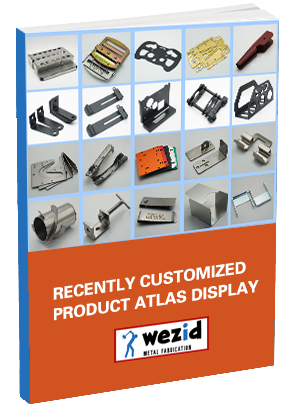
- Custom parts gallery — examples of the parts described on this page.
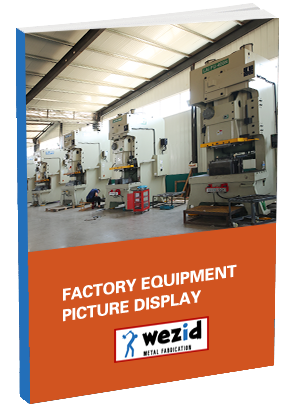
- Equipment list — the press, laser and machining capacity behind them.
- Metal fabrication glossary — the terms that come up when a drawing is discussed.
Send your application
Send us the drawing and the quantity. We quote custom metal parts by industry from your drawing, and we will tell you which process route fits, what tooling it needs and what it costs. Write to maggie@weizhimetal.com or call +86 18892239158.