
Deep Drawing Process vs. Metal Stamping: How Engineers Choose the Best Manufacturing Method
When customers submit RFQ drawings, they often specify either metal stamping or deep drawing process. However, experienced manufacturers know that the process shown on a drawing is not always the best choice for production.
Selecting the wrong process can increase tooling costs, require additional forming operations, and create quality issues during mass production.
Deep Drawing process vs. Metal Stamping: What’s the Difference?
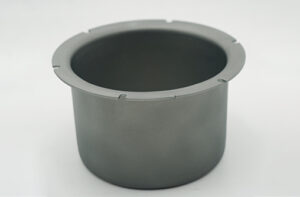
The main difference between the two processes lies in the way the material is shaped. Metal Stamping primarily forms the parts’ shapes through local stamping and bending. At the same time, the deep drawing process forms the deep cavity structure by allowing the material to flow continuously.
| Comparison | Metal Stamping | Deep Drawing Process |
|---|---|---|
| Forming Method | Blanking, punching, bending, and localized forming | Continuous material flow through deep drawing |
| Typical Applications | Brackets, clips, flat panels, and structural components | Enclosures, housings, cups, cans, and deep cavity parts |
| Suitable Part Geometry | Flat or shallow-formed components | Cylindrical, box-shaped, or deep-drawn components |
| Material Deformation | Localized deformation | Uniform material flow across the entire part |
| Tooling Investment | Lower tooling cost | Higher initial tooling investment for dedicated dies |
| Production Stability | Best suited for simple geometries | Better dimensional consistency in high-volume production of deep or complex parts |
| Common Forming Challenges | Springback, localized deformation, dimensional variation | Wrinkling, tearing, wall thinning |
Why Don’t We Quote Directly from Customer Drawings?
Many customers would ask us: “The stamping process has already been specified in the drawings. Why do you still need to re-evaluate it?”
The answer is quite simple. The drawings describe the product, not the manufacturing process.
The design engineer focuses on the product’s functionality, while the manufacturing engineer needs to consider:
- Can the material be formed stably?
- Is the tooling easy to maintain?
- Can the consistency be maintained during mass production?
- Are there any solutions with lower life cycle costs?
Therefore, before preparing quotations, we always conduct a DFM analysis, rather than quoting directly from the drawings.
Case Study: Why We Recommended Deep Drawing Process Instead of Metal Stamping
A medical equipment customer requested the development of a stainless steel casing. During the RFQ stage, the customer’s drawings clearly indicated the use of metal stamping. According to the drawing requirements, we can provide a quotation directly.
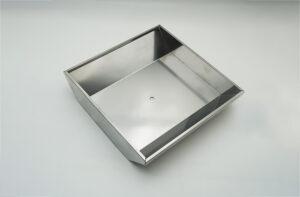
However, before submitting the formal quotation, our engineering team first completed a round of structural assessment. During the assessment, we found that although the part could be fabricated as a sample via stamping, the key areas had a relatively high deep-drawing ratio. If the mold was developed directly through the stamping process, additional shaping processes might be required during subsequent mass production to ensure dimensional consistency.
Therefore, instead of simply quoting based on the drawings, we simultaneously provided the client with two alternative manufacturing plans.
Option 1: Continue using metal stamping
- The cost of the tooling is relatively low
- It is more suitable for small and medium batch production
- Later, additional shaping processes may be required
- There is a larger space for process adjustment
Option 2: Adopt Deep Drawing Process
- The initial investment in tooling is relatively high
- It can reduce subsequent shaping processes
- It is more suitable for long-term stable mass production
- The product consistency is higher, and the life cycle cost is lower
Taking into account the projected annual demand of the product and the long-term production plan, the customer ultimately chose the second option.
For customers, the true value lies not merely in changing the processing method but in choosing a more suitable manufacturing plan for the product before the tooling is made, thereby avoiding the time and cost losses caused by repeated adjustments later on.
The customer didn’t choose the more expensive option. They chose the option with the lowest total manufacturing cost over the product’s lifecycle.
Why Process Selection Should Happen Before Tooling Begins
The structure, materials, and production targets of each product differ, and no single process applies to all components.
Therefore, instead of simply following the drawings for processing, we will consider the product structure, production volume, cost targets, and manufacturing feasibility to help customers evaluate the most suitable processing plan.
For many projects, the engineering assessment is often more important than the quotation itself.
A correct choice of process not only reduces the risk of mold development but also minimizes subsequent production adjustments, thereby improving the overall delivery efficiency of the project.
Get a Process Recommendation Before Tooling Starts✅ Deep drawing vs stamping evaluation • DFM optimization • Process recommendation
Upload your drawings for a free process evaluation & DFM analysis. |
📩 Response within 2 hours · DFM feedback and quotation within 24 hours
|
Related Posts
-
Press Brake Springback: Why Bends Overshoot and How Factories Compensate
Press brake springback is elastic recovery: when the brake releases, the part straightens a few ...
-
Deep Drawing Sheet Metal: Draw Ratios, Limits & Multi-Hit Setup
Deep drawing sheet metal is a forming operation: a punch pulls a flat blank into a cup or pan sh ...
-

Sheet Metal Gauge Chart: Thickness, Strength & Cost by Gauge
This sheet metal gauge chart is the reference our press engineers use before quoting. Gauge is a ...