
Sheet Metal Fabrication Process Guide: Choosing the Right Process Route for Your Part
 To source good sheet metal parts, you do not need to master every detail of fabrication — you need to know which process combination fits your part. The wrong route means unnecessary tooling costs, longer lead times, or quality that drifts as volume changes. A clear sheet metal fabrication process guide helps you match the process to the part, not the other way around.
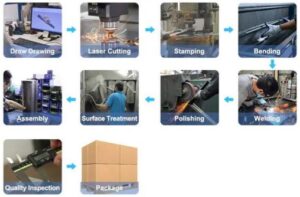
Four families of processes determine how the part is made—cutting, forming, joining, and finishing—while volume, geometry, material, tolerance, and use environment determine which family to choose. This sheet metal fabrication process guide walks through those four decisions and how to apply them order by order.
Sheet Metal Fabrication Process Guide: Four Route Decisions
Real process-route selection is not an equipment list — it is a DFM judgment: the same part may have two or three viable routes, and the engineer must pick the most suitable one based on quantity, material, geometry, tolerance, and lifecycle cost. The four decisions below apply that judgment, decision by decision.
Decision 1 — Cutting: Laser, Stamping, or Waterjet?
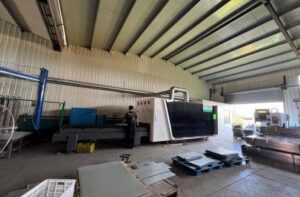 Cutting separates the blank from the sheet, and the method follows your volume and geometry. Laser cutting suits complex 2D profiles at low to medium volumes—no tooling cost, but actual dimensional accuracy depends on material thickness, machine condition, geometry, and heat effects; confirm critical features against the specific drawing. Stamping blanking suits high volumes with dedicated dies: the lowest per-part cost once you amortize the die. Waterjet handles thick or heat-sensitive materials. Ask: what is my volume, how complex is the profile, how thick is the material?
Decision 2 — Forming: Press Brake or Stamping?
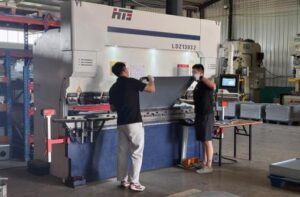 Forming creates the 3D geometry. CNC press braking is a flexible choice for small to medium batches with no tooling cost; conventional angle and dimensional tolerances depend on material, thickness, bend length, tooling, and geometry—common engineering ranges are about ±0.5–1° for angles and ±0.2–0.5 mm for dimensions. Still, confirm critical dimensions through the drawing and process review. Stamping and deep drawing (up to 400 tons) suit high volumes and complex shapes with tighter positional tolerances, spreading tooling cost across the run. Ask: how many parts, how complex is the geometry, how tight are the tolerances?
Decision 3 — Joining: Weld or Mechanical Fastening?
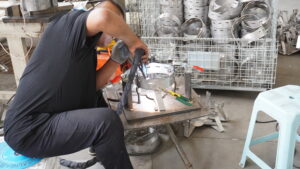 Joining completes the assembly. MIG and TIG welding deliver high structural strength; for thin-wall parts or distortion-sensitive structures, spot welding, clinching, or mechanical fasteners (rivets, PEM inserts) are sometimes the better choice. The decision cannot rest on equipment capability alone — deformation, appearance, strength, and downstream finishing all matter. Welded assemblies realistically hold ±0.5 mm or wider because heat causes distortion; the fix is sequencing, fixtures, and sometimes redesign.
Decision 4 — Finishing: Coating, Plating, or Anodizing?
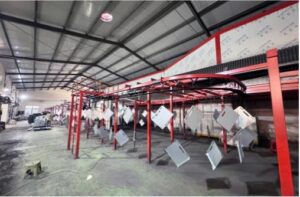 Finishing protects the surface and sets the appearance: powder coating for durability and color, plating (zinc, nickel) for corrosion resistance, anodizing for aluminum, plus passivation and silkscreening. Finishing isn’t a last-minute step— consider it during material and structure design: will liquid pool inside bends, do welds need grinding, do holes need masking, does plating change dimensions, and do mating surfaces need protection after coating? Pretreatment (degreasing, phosphating) determines coating adhesion, so the finishing line matters as much as the coating itself.
Applying the Sheet Metal Fabrication Process Guide: Match the Route to Your Volume
Volume is the strongest signal in route selection because it decides where tooling cost is justified. The decisions above form a working sheet metal fabrication process guide when applied to three typical order ranges:
| Volume range | Cutting | Forming | Joining |
|---|---|---|---|
| Prototype / low volume (1–100) |
Laser | Press brake | Mechanical fastening or light welding |
| Medium (100–5,000) |
Laser or light stamping | Press brake | Welding or spot welding |
| High (5,000+) |
Stamping | Stamping / deep drawing | Spot welding |
These volume ranges are a starting point for process selection, not fixed thresholds — the final route should be determined by part geometry, material, tolerances, and lifecycle requirements.
The goal is not the most advanced process — it is the most matched process. A route chosen for ten prototypes will waste money at ten thousand units, and a route chosen for mass production will delay a prototype. Because route choice drives cost, our custom sheet metal fabrication cost guide breaks down how each process decision moves the quote; when you evaluate suppliers, our OEM sheet metal fabrication partner evaluation guide shows how to verify the process capabilities behind the route.
How We Execute Process Routes
The worst route selection happens when a factory only offers what it owns. We design the route for your part first. Weizhi Metal runs every stage in-house in Nanpi, Cangzhou—part of the Nanpi hardware industry cluster, where sheet metal fabrication support is concentrated in one region.
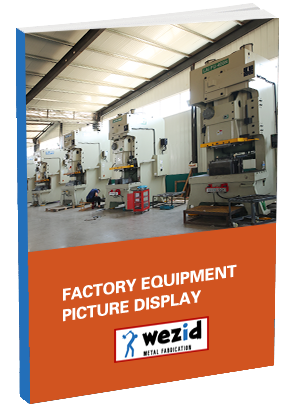
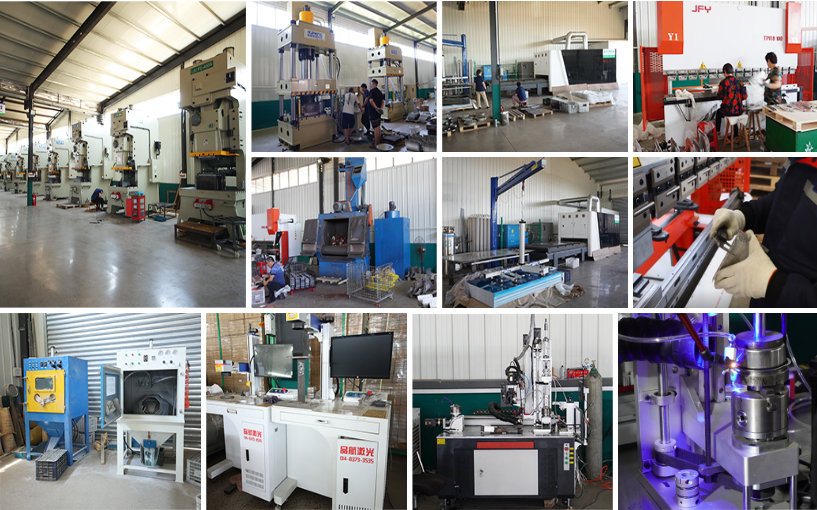 Two 6 kW laser cutters handle complex profiles and low- to medium-volume work. 40+ stamping presses, up to 400 tons, including deep drawing, take over high-volume production. A CNC press brake line, in-house welding lines, and an in-house coating line complete the remaining processes.
When your volume grows from prototype to production, the route switches within one factory. You do not need to change suppliers. We complete core cutting, forming, welding, and finishing within our own production system. The cluster advantage is that materials, tooling, and supporting resources can quickly cover special requirements.
Nineteen engineers review every drawing before quoting, so we recommend the route based on engineering judgment, not what is easiest to run. Inspection follows the evidence chain. CMM machines measure at the micron level; every prototype ships with FAI; and every batch ships with inspection reports and material certificates under an ISO 9001:2015 system.
Since 1999, we have delivered 70,000+ custom part numbers to 3,000+ companies in 100+ countries, with a firm delivery date on every order and a 5.0/5 customer satisfaction score. Route advice is part of quoting, not an upsell: you get a recommended route and the reasons behind it before any tooling commitment. Send us your drawing — our engineers will recommend the route, free of charge.
Questions? The FAQ below covers the essentials — or upload your drawings to get started.
FAQ
|
Unsure of the Right Process Route? Get a Free Recommendation ✅ 25+ years · 120 employees · 70,000+ parts · ISO 9001
Upload your drawing — engineers recommend the process route before quoting |
📩 Response within 2 hours · DFM feedback and transparent quote within 24 hours
|
Related Posts
-
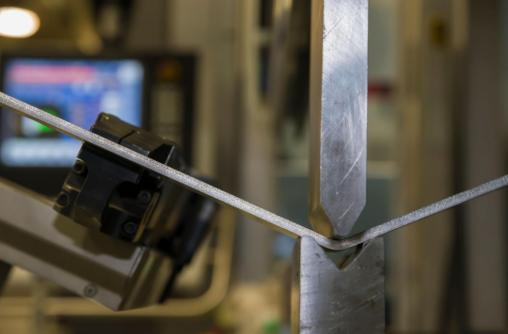
Press Brake Springback: Why Bends Overshoot and How Factories Compensate
Press brake springback is elastic recovery: when the brake releases, the part straightens a few ...
-
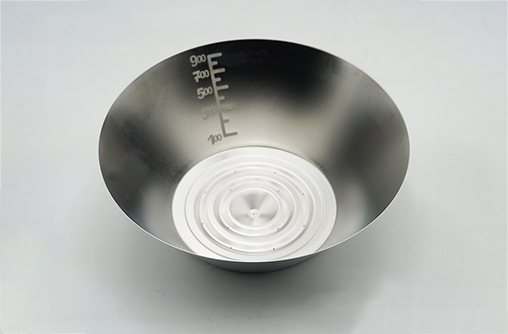
Deep Drawing Sheet Metal: Draw Ratios, Limits & Multi-Hit Setup
Deep drawing sheet metal is a forming operation: a punch pulls a flat blank into a cup or pan sh ...
-

Sheet Metal Gauge Chart: Thickness, Strength & Cost by Gauge
This sheet metal gauge chart is the reference our press engineers use before quoting. Gauge is a ...