
Stainless Steel Enclosure Manufacturer: 20+ Years of Fabrication Experience
A food processing plant in a coastal Southeast Asian country shut down for three days. The cause: a stainless steel enclosure that had been installed for only six months—corroded from the inside out by salt-laden air that had penetrated through a failed weld seam.We were not the manufacturer of that enclosure — but we’re the stainless steel enclosure manufacturer they called after production stopped.
——Next, you will see: how to select materials, how to control the process, how to test the quality, and how to carry out customization.
Material Selection Determines Stainless Steel Enclosure Performance
Most purchasers are aware of the differences between 304 and 316 stainless steel. But they don’t always understand what that difference actually means in enclosure fabrication — or that choosing the wrong material can shorten an enclosure’s service life by years.
Direct comparison:
However, a detail many overlook: enclosures require welding, and the weld seam is the weakest point of the entire structure. The heat-affected zone can reduce local corrosion resistance—which is why 304L and 316L (low-carbon grades) are typically the better choice for welded enclosures. Material selection also affects fabrication: stainless steel work-hardens more than carbon steel, requiring adjusted bend allowances for an accurate fit and seal.
For a side-by-side comparison of 304 and 316 across different environments, see our detailed guide: 304 vs 316 Stainless Steel: Selection Tips from Our Factory Floor Experts.
Manufacturing Processes for Reliable Stainless Steel Enclosures
Whether a case is reliable or not can be determined by looking at its weakest weld point. For a stainless steel case, the weakest part is almost always the weld seam.
Stainless steel is much more difficult to handle than carbon steel. It has a large thermal expansion coefficient, poor heat conductivity, and is more prone to deformation during welding. A factory that fails to understand the temperament of stainless steel will end up with cases where the panel is warped, the gaps are uneven, and areas with concentrated stress are prone to rusting. All of these problems are caused during the welding process.
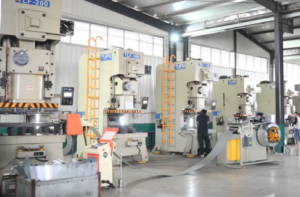
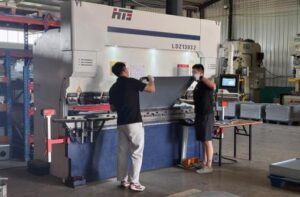
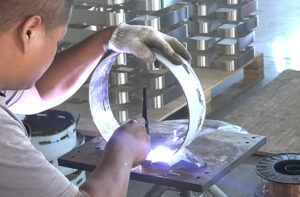
Stainless Steel Enclosure Manufacturing Process
Laser cutting
The 6KW laser cutting provides the first level of precision guarantee – the cuts are clean, the heat-affected zone is small, and the key dimensions can be controlled within ±0.1mm. If there are burn marks or burrs on the cuts, they will be the starting point for future rust and can also cause trouble during welding when they don’t align properly.
The 80-400 ton Stamping machine is responsible for installing features such as holes, heat-dissipation holes, and knockdown holes. The advantage of the press machine lies in its efficiency and consistency. When producing in large quantities, the position and size of each hole are the same, and there is no thermal impact from laser cutting.
Make sure the box is straight before welding. If it is bent out of shape, it won’t be straight even after welding. We double-check the angle and size of each bend.
For mass-produced stainless steel computer cases, automatic spot
The depth of a factory’s understanding of stainless steel can be gauged by examining the details: Did the weld seams avoid areas of high stress concentration? Can the tooling and fixtures control the deformation? Did the acid pickling and passivation after welding restore the protective layer properly? These are not optional features.
With 26 years of sheet metal fabrication experience, our factory integrates laser cutting, stamping, CNC machining, welding, and surface finishing under one production system.
Quality Control for Stainless Steel Enclosures
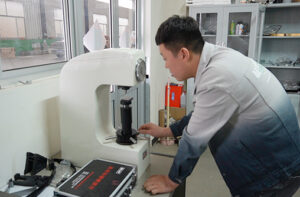 |
As a responsible stainless steel enclosure manufacturer, we back every shipment with comprehensive test reports. Key inspections include dimensional accuracy verification using coordinate measuring machines (CMMs), material hardness testing, tensile strength validation, and, where required, flaw detection. After working in this industry for a long time, one realizes that there has never been a shortage of inferior materials passing off as good ones on the market – the report is the only reliable basis for tracing. |
The welding quality is controlled through visual inspection and penetrant testing to ensure the absence of defects such as cracks, pores, undercutting, or incomplete fusion. The weld seam cannot just “look okay” – it must be able to withstand actual use in the field.
For OEM customers, the first piece being qualified is merely the beginning. What truly matters is that after mass production, the 100th piece, the 1000th piece, etc., still maintain the same dimensional accuracy and assembly consistency.
ISO 9001:2015 deals with the quality management system — it doesn’t guarantee that the computer cases you receive will be of good quality. Still, it can indicate that this factory has rules and doesn’t rely on luck for its deliveries.
Custom Stainless Steel Enclosures: Built for Your Application
Standard-sized chassis rarely can fit standard-sized equipment exactly.What we can do is full-process customization:
You provide 2D drawings, 3D models, or just describe the requirements verbally. We will convert them into manufacturable engineering plans for you.
Based on the usage environment (temperature, humidity, chemical contact, expected service life), we can help you determine the most suitable metal material.
Wall-mounted, floor-standing, frame-style, 19-inch rack-style, all of which are available.
Connector openings, cooling systems, cable entrances, observation windows, door body configuration, hanging points — all designed as per your needs.
Different industries have different requirements:
Data center: Server cabinets and network enclosures, with high requirements for cooling management and cable routing.
Food and Beverage: Frequent cleaning is required. The weld seams must be corrosion-resistant, and the surface should be easy to clean.
Industrial Automation: PLC cabinets and control boxes should be easy to install and facilitate later maintenance.
Customization is not about randomly drilling holes in a standard chassis. Our engineering team will review every customization project, taking into account both the feasibility of the manufacturing process and the reliability of its use in the field.
Why Choose This Stainless Steel Enclosure Manufacturer
This is the result of making the right choices consistently: using the right material for the environment, following proper processes, verifying through testing, and designing specifically for each application.
We are not the lowest-priced stainless steel enclosure manufacturer. We are the ones you install and forget.
Need a Stainless Steel Enclosure That Lasts?✅ 20+ Years of Fabrication Experience · Engineering-driven quality
“We don’t just build enclosures — we build enclosures that survive.” |
📩 We’ll review your application and get back to you within 24 hours.
|
Related Posts
-
Press Brake Springback: Why Bends Overshoot and How Factories Compensate
Press brake springback is elastic recovery: when the brake releases, the part straightens a few ...
-
Deep Drawing Sheet Metal: Draw Ratios, Limits & Multi-Hit Setup
Deep drawing sheet metal is a forming operation: a punch pulls a flat blank into a cup or pan sh ...
-
Sheet Metal Gauge Chart: Thickness, Strength & Cost by Gauge
This sheet metal gauge chart is the reference our press engineers use before quoting. Gauge is a ...