
Metal Enclosure Manufacturer: How 20 Years of Stamping Experience Ensures Reliable Production
In the sheet metal enclosure industry, production capability is not only measured by the number of processes a factory offers. Long-term reliability comes from deep expertise in key manufacturing processes and the ability to integrate multiple processes together. The metal enclosure manufacturer that can survive for 20 years and consistently receive repeat orders are often those with long-term expertise in a core process and a well-coordinated set of supporting processes.
Why Stamping Experience Matters for a Reliable Metal Enclosure Manufacturer
The stamping process has a characteristic: the mold only needs to be pressed down for one second, but how to design the mold, how much material will rebound, and how to avoid stretching cracks – all these judgments cannot be made without 20 years of case accumulation.
For the same 2.0mm galvanized sheet, materials produced by different steel mills have different tensile strengths, and the rebound amount after stamping can differ by 0.2mm. Technical manuals provide general parameters, but they cannot account for every material variation during actual production. Experienced engineers know how to adjust springback compensation based on real production feedback.
These accumulated experiences allow engineers to identify potential risks before mass production begins.
-
Springback compensation coefficients for different materials (SPCC, SECC, SUS304, AL5052) at various thicknesses
-
Which shapes are prone to cracking during deep drawing and require pre-cut relief holes
-
How to lay out progressive dies for maximum material utilization
These things cannot be learned from textbooks. They can only be summarized from each batch of qualified products and each piece of waste.
When a metal enclosure manufacturer claims to have 20 years of experience, they are essentially saying: The problems you have in your drawings are likely ones that I have encountered and solved before.
80-400 Ton Stamping Capacity for Different Enclosure Requirements
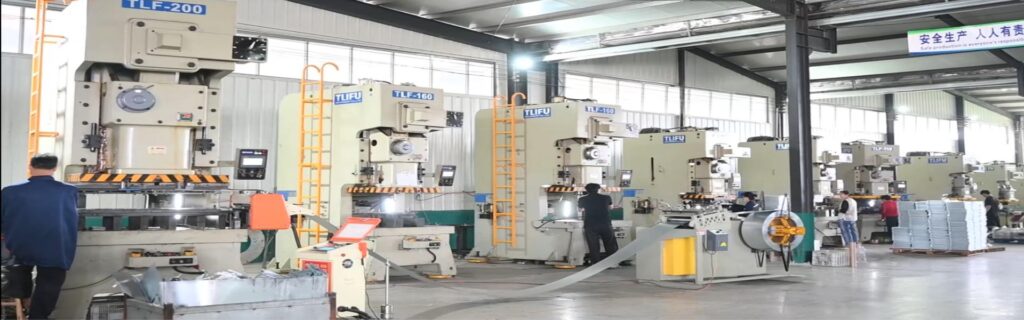
The core equipment for stamping is the stamping machine. Higher tonnage does not always mean better performance. The key lies in “meeting the category demands of customers”. The 80- to 400-ton range covers the mainstream requirements for metal enclosure products.
| Tonnage Range | Applications |
|---|---|
| 80-160T | Thin sheet (0.8-2.0mm), 1U/2U chassis panels, heat sinks, electronic component enclosures |
| 200-315T | Medium sheet (2.0-4.0mm), mid-size chassis, bracket parts, door panels |
| 400T | Thick sheet (4.0-6.0mm+), large equipment enclosures, deep-drawn parts |
The laser cutting machine is responsible for material cutting and processing of irregular holes. In contrast, the bending machine performs a few supplementary bending processes – but the core “forming” is accomplished by stamping. Stamping provides excellent repeatability and dimensional consistency for high-volume production, and the single-piece cost is the lowest.
For large-scale orders, the purchaser will prefer to look for stamping-based metal enclosure manufacturers – stamping usually has obvious advantages in terms of unit cost and consistency.
The Manufacturing Details Behind Stable Stamping Quality
Tooling Life Management
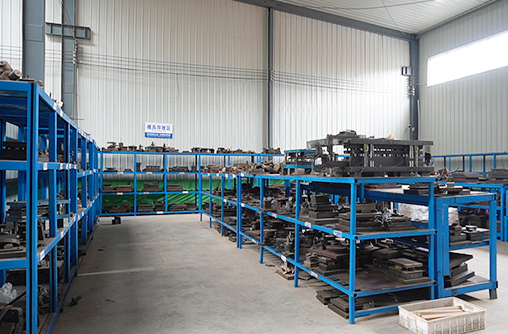
Tooling condition is one of the key factors affecting stamped part accuracy. No matter how new the equipment, once the cutting edge wears, dimensions drift.
Professional manufacturers maintain records for every tool: stroke count, sharpening cycles, maintenance history. A well-maintained tool can stamp hundreds of thousands of parts within tolerance.
First Article Inspection
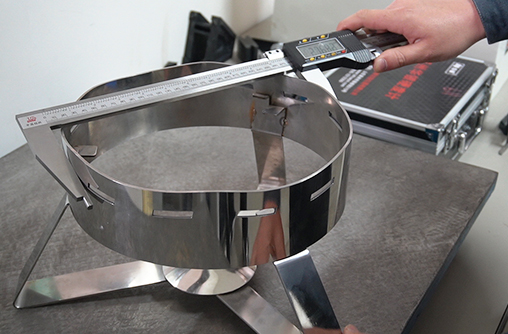
Every tool change and new material batch requires full dimensional inspection — calipers, height gauges, CMM for critical dimensions. Production starts only after first article passes.
This is one of the most important checkpoints for preventing large-scale production issues. 20 years of experience means engineers can quickly diagnose if the issue is tooling or material — and know exactly what to adjust.
Process Stability
Dimensional variation in stamping comes mainly from tool wear and material batch differences. SPC-controlled factories sample at fixed intervals and chart the data.
It tells you exactly how much the 5,000th part differs from the first — that’s what buyers really care about.
Data monitoring → Trend detection → Consistent output
Real Case: Preventing Production Risks Before Mass Manufacturing
A customer who produces outdoor communication sealing components sent us a set of drawings. The material was marked as 2.0mm SUS304 stainless steel. The part was a ring-shaped stretched flange with continuous locking teeth on the outer ring, and the stretched depth of the cylindrical cavity was 32mm. The customer had previously sought quotations from two stamping factories. Other suppliers had already reviewed the project, but during our DFM evaluation, we identified a potential production risk.

Identify the problem
The 32mm stretching depth is already close to the safety limit for a single-stretch operation on 2.0mm ordinary 304 stainless steel. If stretched directly according to the conventional parameters, problems such as occasional hidden cracks at the tooth root and the cylinder wall occurred during mass production – not every piece cracked, but perhaps 2-3 pieces out of every 50 would. This kind of occasional hidden crack is the most difficult to control: the first piece was qualified, the small batch was qualified, but it was only intermittently exposed during the thousands-piece mass-production stage. Subsequently, galvanizing treatment was required, and the cracks would be covered by the coating, making it very likely to cause a sealing failure upon delivery to the client. Whether through full inspection and picking or complete batch scrapping, it will result in significant losses.
The conventional solution is to install a set of pre-stretching molds and add an extra process, which will increase mold costs by approximately 9,000 yuan and extend the construction period.
Our engineers came up with a new approach:
The problem lies in the insufficient ductility of the material, so it is not necessary to solve it on the mold. There are differences in the tensile properties of 304 stainless steel by brand. The deep drawing performance of ordinary 304 is limited. A deep-drawing grade of SUS304 with improved formability was recommended to reduce the risk of cracking, with the unit price being basically the same. Changing to a different material brand reduces the tensile risk.
At the same time, the radius of the concave die’s rounded corner was increased from R2.5 to R4. This very simple modification does not increase the cost of the part. It can be accomplished simply by polishing and trimming the mold. After the R angle was enlarged, the material flow resistance decreased, and reducing material thinning during the drawing process.
The client agreed to the material substitution and mold fine-tuning plan.
Ultimately, 6,000 pieces of flange parts for this project were successfully mass-produced. The stretching process did not result in any cracking issues, and it also avoided the need for additional pre-stretching molds and extra processing steps.
For OEM buyers, choosing a metal enclosure manufacturer is not only about production capacity.
It is about finding a partner who can identify manufacturing risks before mass production and maintain stable quality throughout the entire production cycle.
20 Years of Stamping — From Tooling to Production✅ 38 stamping · 80-400 tons · Tooling life management
“We don’t just stamp parts — we make sure every batch is consistent.” |
📩 We’ll review your drawings and provide manufacturing feedback within 24 hours.
|
Related Posts
-
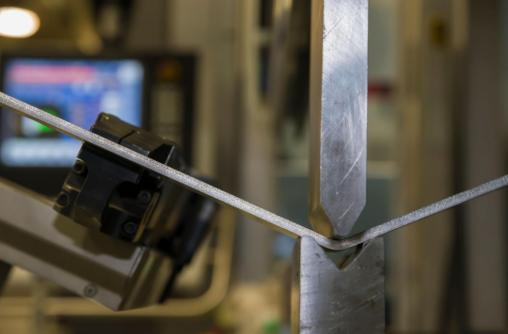
Press Brake Springback: Why Bends Overshoot and How Factories Compensate
Press brake springback is elastic recovery: when the brake releases, the part straightens a few ...
-
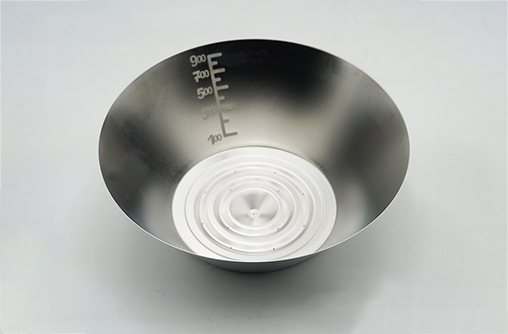
Deep Drawing Sheet Metal: Draw Ratios, Limits & Multi-Hit Setup
Deep drawing sheet metal is a forming operation: a punch pulls a flat blank into a cup or pan sh ...
-

Sheet Metal Gauge Chart: Thickness, Strength & Cost by Gauge
This sheet metal gauge chart is the reference our press engineers use before quoting. Gauge is a ...