
Why Your Metal Bending Parts Don’t Fit Together
The underlying cause is usually not a single-point processing error, but rather a systematic deviation between the design and the manufacturing process.

Why Single-Part Qualification Does Not Guarantee Assembly Success
One of the first mistakes in many OEM projects is to treat “dimensional compliance” as a sufficient condition for “successful assembly”; however, in metal bending, the two are not equivalent.
Cumulative Errors in Metal Bending Assembly
Even if a single part is completely within the tolerance range, when multiple parts are combined, the following situations may occur:
• The holes gradually shifted
• The frame closure failed
• The assembly stress was forcibly released
The core of the problem lies in: The errors accumulate rather than occur independently.
Misalignment Caused by Inconsistent Reference Datums
When different processes use different benchmarks (bending, stamping, welding), even if each step is qualified, an overall offset will still occur.
Hidden Errors in Metal Bending That Affect Assembly Accuracy
In actual production, metal-bending errors do not appear directly in the inspection report; instead, they are concealed within the processing path.
The geometric changes during the bending process are irreversible.
When metals are bent, they undergo structural deformation, and this change will affect:
• Relative positions of holes
• Edge straightness
• Angle relationships of multiple folds
How Process Sequence Impacts Assembly Accuracy
The same set of drawings, if the processing sequence is different, the results may be completely different. For example:
• Bending first vs Drilling later
• Segmental processing vs. integral molding
These differences will not affect the single-piece qualification rate, but they will directly influence the assembly outcome.

Why Samples Pass but Mass Production Fails in Metal Bending
This is the most common OEM problem, and it is also the stage at which metal bending is most prone to misjudgment.
- Single-piece production
- Manual correction
- Non-standard tooling
- Workpiece wear
- Batch fluctuations
- Operational consistency differences
- Process switching errors
These factors combined have led to a concentrated outbreak of assembly failures.
Engineering Solutions to Metal Bending Assembly Problems
The key to solving this problem lies not in “improving the precision of a certain process” but in establishing a systematic control logic.
Our engineering approach is based on the summary of long-term OEM project experience:
- Is the bending sequence reasonable?
- Does the structure have cumulative error paths?
- Are there any benchmark conflicts?
Engineering Experience Behind Metal Bending Assembly Control
This systematic issue is not the result of theoretical derivation but rather a conclusion repeatedly verified over the long-term OEM delivery process.
In our engineering practice, we have dealt with over 70,000+ different structural parts. We have consistently observed the same pattern in automotive, industrial equipment, electronic, and structural component projects:
The metal bending assembly failure does not usually result from a single dimension error, but rather from the failure of the system’s design assumptions.
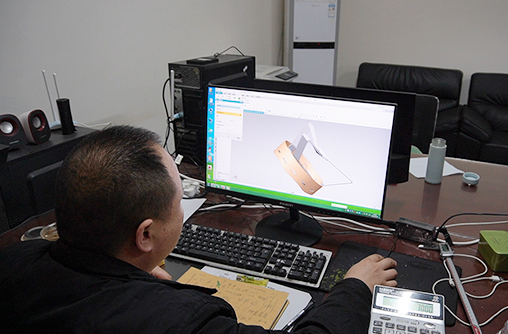
The engineering support we offer
| To reduce the risk of assembly, we offer pre-engineering support:
• Free DFM Design Optimization – Early identification of assembly risks and structural conflicts |
 |
Conclusion
The real challenge of metal bending is not whether it can be accomplished, but whether it can maintain consistent assembly quality during mass production.
When assembly failures occur, the problem usually does not lie in the processing stage, but rather in whether a complete engineering control system has been established between the design, process, and manufacturing systems.
For OEM projects, the earlier these risks are identified, the easier it will be to avoid subsequent rework and quality fluctuations.
How to Choose a Reliable Metal Bending Supplier
When choosing a metal bending supplier, one should not only focus on processing capabilities and quotations but, more importantly, assess whether the supplier has the engineering capabilities to support the project’s stable mass production.
A supplier that is worth long-term cooperation usually should have the following characteristics:
– Does it offer DFM design optimization to identify and resolve potential assembly risks before production?
– Does it possess a complete manufacturing collaboration capability to ensure that bending, stamping, welding, inspection, and other processes follow unified engineering standards?
– Does it have mature project experience to quickly identify risks and propose optimization suggestions based on different product structures?
– Does it establish a comprehensive quality management system that ensures consistency from samples to mass production through standardized processes and testing methods?

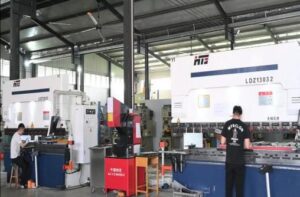
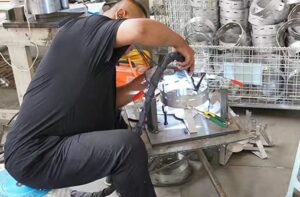
Take our team as an example. We have 19 engineers, each with more than 10 years of industry experience. They not only support part manufacturing but also contribute to DFM optimization, process planning, and assembly risk assessment.
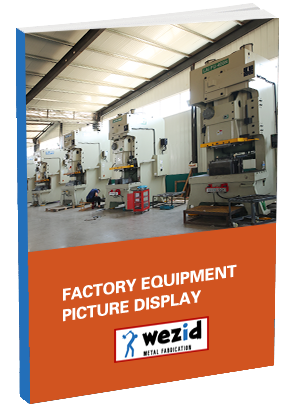
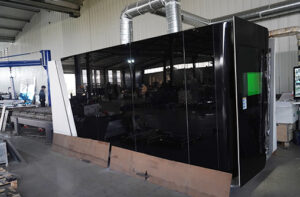
During production, we follow a complete manufacturing and quality control process. Our facility is equipped with 40 stamping machines (80–400 tons), 3 bending machines, automatic spot welding equipment, welding production lines, and 2 Coordinate Measuring Machines (CMMs). Together, these resources help ensure consistent quality from forming and welding to final dimensional verification.
As a result, our customers achieve greater consistency in metal bending projects, from prototype development through mass production.
To date, we have manufactured more than 70,000 customized parts for over 3,000 enterprises across 100+ countries. Supported by our ISO 9001:2015 quality management system, we continuously improve our production processes to ensure consistent quality and reliable batch production.
Additionally, we provide free DFM design optimization for OEM projects. By identifying assembly risks before production begins, we help customers avoid costly problems during mass production.
Metal Bending Parts Not Fitting?✅ DFM analysis · Assembly risk identification · Process optimization
Upload your drawings for a free DFM assembly evaluation. |
📩 Response within 2 hours · DFM feedback and quotation within 24 hours
|
Related Posts
-
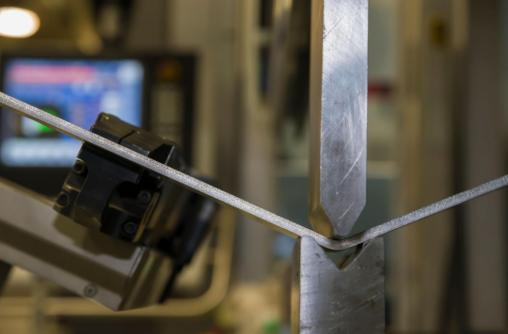
Press Brake Springback: Why Bends Overshoot and How Factories Compensate
Press brake springback is elastic recovery: when the brake releases, the part straightens a few ...
-
Deep Drawing Sheet Metal: Draw Ratios, Limits & Multi-Hit Setup
Deep drawing sheet metal is a forming operation: a punch pulls a flat blank into a cup or pan sh ...
-

Sheet Metal Gauge Chart: Thickness, Strength & Cost by Gauge
This sheet metal gauge chart is the reference our press engineers use before quoting. Gauge is a ...