
Inside a Real Metal Fabrication Factory: How Custom Metal Parts Are Manufactured
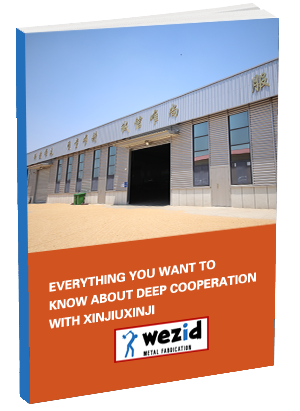
A true one-stop metal fabrication and manufacturing process does not involve splitting the drawings among multiple factories for production. Instead, it completes all core manufacturing processes, from raw materials to finished products, within the same factory. As a metal fabrication factory with a production area of over 9,000 m², we have a comprehensive production system and equipment.
Today, we will take you to the production site to show you, step by step, how a custom metal part is manufactured.
Self-owned production workshop
Stamping and stretching equipment cluster
CNC machining accuracy
Customized parts experience
Daily output
Metal Fabrication Process: Starting With Metal Sheets
In most cases, the production of chassis, brackets, enclosures, and structural components begins with metal sheets.
Laser Cutting: The First Step of Precise Manufacturing
In the production workshop, two 6KW fiber laser cutting machines are operating simultaneously. Whether it’s thin plates, thick stainless steel plates, or complex-shaped parts, they can all be formed in one go through laser cutting. Laser cutting not only ensures dimensional accuracy but also effectively improves material utilization, laying the foundation for subsequent processing. For custom metal parts, this is one of the most important starting points in the entire manufacturing process.
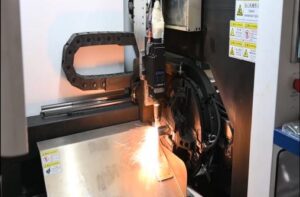
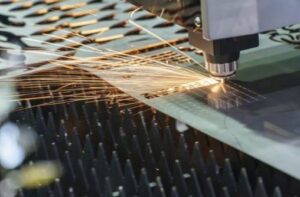
Stamping and Stretching: Achieving High-Efficiency Mass Production
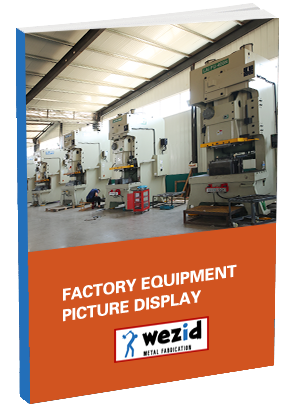
When the order enters the mass production stage, the stamping process will play a crucial role. Our stamping workshop is equipped with:
|
• 40 sets of 80T-400T stamping machines Capable of completing: blanking, punching, forming, shallow stretching, and deep stretching. For complex structural components such as cup bodies, shells, and cover bodies, the hydraulic stretching process can achieve high consistency in mass production. 44 pieces of equipment operate in the same workshop, enabling us to respond quickly to large-scale orders. |
|
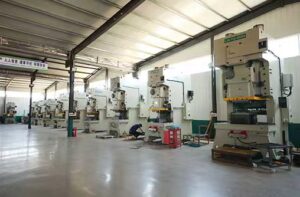
Stamping is a key process in large-scale metal fabrication factory production.
Bending and Welding: Building Three-Dimensional Structures
After being cut and stamped, the metal materials need to be further shaped into the final structure.
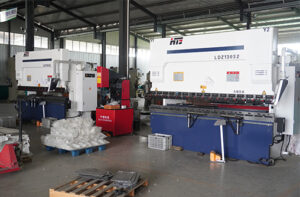
| Bending Processing
With three sets of professional bending equipment, we can perform sheet metal bending, pipe bending, and complex angle forming, ensuring the parts meet assembly requirements. Various Welding Techniques Then the welding process follows. The factory has: • Automatic spot welding equipment Based on the product structure and material properties, select the most suitable welding method. Welding not only affects the appearance of the product but also directly determines the structural strength and service life. |
|
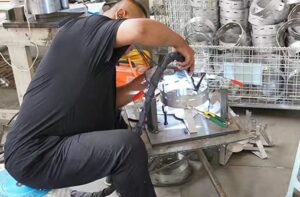
Fine Processing: Drilling, Marking and Structural Optimization
After the product enters the subsequent stage of manufacturing, various auxiliary processes are often required. Equipment in the workshop:
• 12 drilling machines
• 4 laser marking machines
Capable of performing: precise drilling, thread processing, product coding, traceability marking, and brand LOGO engraving. These detailed processing steps ensure that the products can smoothly proceed to the assembly and end-user usage stages.
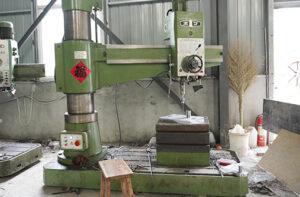
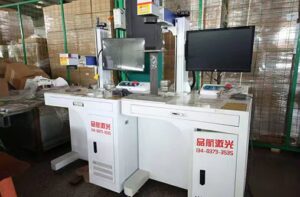
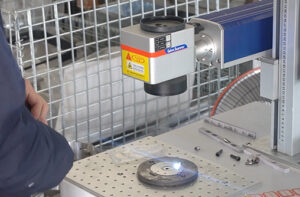
In-House Casting Capability
Not all parts can be manufactured from sheet materials. For products that bear high loads, impact forces, or have complex internal structures, we will use casting techniques to produce the blanks. The factory has a complete casting production capacity and can produce:
• Carbon steel castings
• Alloy steel castings
After the casting process is completed, the raw materials do not need to be sent out. They can directly proceed to the subsequent CNC precision processing stage. This internal collaborative capability can effectively shorten the production cycle and reduce the difficulty of supply chain management.
CNC Machining for Precision Metal Parts
Whether it is a sheet-metal part or a casting, once it enters the CNC workshop, it undergoes high-precision processing.Our equipment includes:
| • Multi-axis machining center × 2 —— Completes multi-face processing with one setup• Vertical machining center × 3 —— Suitable for boxes, flanges, supports, and precision structural components |
|
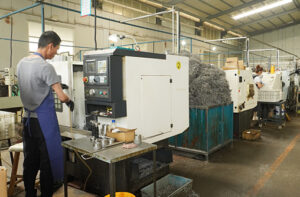
Through precise tools and stable process control, the processing accuracy can reach ±0.01mm. This is also an important guarantee for many high-precision metal parts to meet assembly requirements.
Surface treatment: Enhancing Product Performance and Appearance
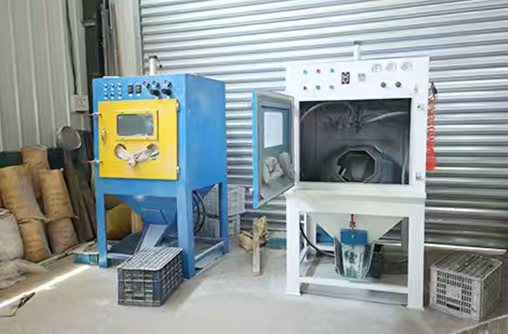
After the mechanical processing is completed, the product will enter the surface treatment stage. All surface treatment processes are carried out within the factory. Common processes include:
|
• Spraying powder Carrying out surface treatment internally can prevent damage during external transportation and improve overall delivery efficiency. |
|
Quality Control Across the Manufacturing Process
High-quality products are not achieved through final inspection but are formed gradually throughout the manufacturing process. Therefore, we have established an independent quality control center. The testing equipment includes:
|
• Complete set of basic measurement tools From the time the raw materials enter the factory until the final shipment, each manufacturing process has corresponding inspection standards. This ensures that the products meet the customer’s requirements for size, performance, and consistency. |
|

Choosing the Right Material
Not every part is best made from the same sheet. Stainless steel resists corrosion, aluminum keeps weight down, special alloys add strength — and carbon steel, stainless, aluminum, copper, brass and special alloys (100+ types) are available in-house. The right choice depends on where the part will live: outdoor exposure, load-bearing structure, or a lightweight target. We match material, performance, cost and process feasibility together before production, so the part is right for its job — not just for the drawing.
Packing: The Final Step of Quality Control
From our factory to your workshop, packaging is treated as the last process of manufacturing, not an afterthought:
• Corrosion prevention — VCI (vapor corrosion inhibitor) packaging and anti-tarnish paper for long sea-freight routes
• Shock absorption — custom-cut foam, EPE, or vacuum-formed trays that hold each part in place
• Logistics-optimized design — stackable, space-efficient, built to survive the journey
• Clear handling labels — identification, weight, center of gravity, and stacking limits on every package
Why Choose Our Metal Fabrication Factory
In addition to the complete manufacturing system, we also have:
• A team of 19 engineers with over 20 years of experience
• Free DFM analysis and material optimization suggestions
• 24-hour rapid response service
• 72-hour sample support
• Over 70,000 customized parts manufactured
• Serving over 3000 industrial customers
• Providing material certificates, test reports, and ISO quality documents
Whether it is for sample development or mass production, we can provide one-stop manufacturing support from design review to final delivery.
Related Posts
-
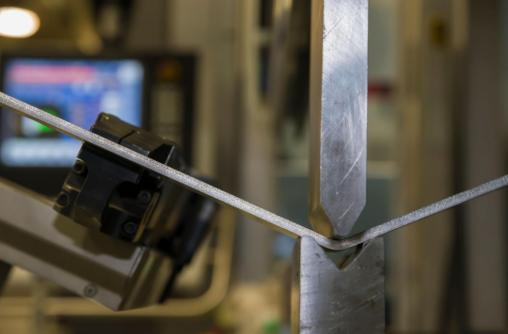
Press Brake Springback: Why Bends Overshoot and How Factories Compensate
Press brake springback is elastic recovery: when the brake releases, the part straightens a few ...
-
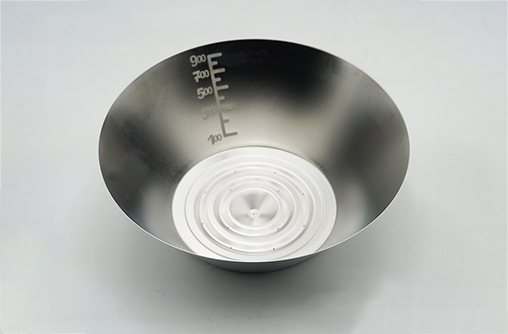
Deep Drawing Sheet Metal: Draw Ratios, Limits & Multi-Hit Setup
Deep drawing sheet metal is a forming operation: a punch pulls a flat blank into a cup or pan sh ...
-

Sheet Metal Gauge Chart: Thickness, Strength & Cost by Gauge
This sheet metal gauge chart is the reference our press engineers use before quoting. Gauge is a ...