
Chinese Metal Stamping Supplier Verification: How to Confirm a Real Factory
How do you confirm a real factory, not a broker?
To verify a Chinese metal stamping supplier, ask for three kinds of evidence in this order: a business licence whose registered scope covers metal manufacturing, a live video tour of the running production floor, and process proof that ties your part to a specific machine and tooling. A trading company can produce a licence and a brochure, but it cannot produce a press with your tooling in it. Therefore, verify the ISO 9001:2015 certificate in the issuing body’s database instead of accepting an emailed PDF. If the supplier defers or refuses any of these three items, you are not talking to a factory.
What evidence separates a factory from a broker?
Buyers often start with the wrong question when they assess a Chinese metal stamping supplier. “Is this a real factory?” invites a yes, because nobody answers no. Consequently, ask the answerable version instead: can this supplier show evidence that only a factory could have?
Process proof is the strongest evidence
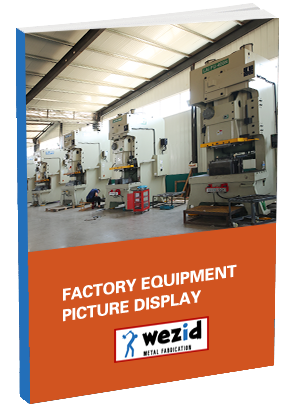
First, request a live video call where the camera follows your part through the plant: material in storage, the die or tooling, the press running, and the first-article check on the bench. Then ask the operator to walk continuously rather than stop in a meeting room. Process proof resists faking, because it requires the equipment to exist and to be running at that moment. For a Chinese metal stamping supplier, this is the most useful single test, since equipment is the one asset a broker cannot borrow for a call.
 Licence scope is necessary, but not sufficient
Second, read the business licence. Its registered business scope should include metal manufacturing or production, and not only trading, import and export. However, treat this as a starting filter rather than proof, because many legitimate factories also register a trading scope for export invoicing.
Verifiable certification
Third, verify the quality certification itself. ISO 9001:2015 is the standard shortlist filter, yet buyers routinely misread what it covers. A certificate proves that a documented quality system exists; it does not prove that every part meets your tolerances. Moreover, the certificate you receive by email proves nothing until a database confirms it. Therefore, always look the number up rather than reading the PDF.
What belongs on an evidence checklist for a Chinese metal stamping supplier?
Build the checklist before you shortlist, and use the same list for every candidate. Because comparison only works on identical criteria, score each supplier against the same eight items.
| Evidence | What to request | How to verify it | Where it usually fails |
| Business licence | Full company name, unified credit code, registered scope | Match the name on the quotation, the bank account and the licence | Quotation from one entity, invoice from another |
| Live production tour | Video call, camera walking the floor | Ask to see your tooling and the press running it | Tour stops at a showroom or meeting room |
| ISO 9001:2015 certificate | Number, issuing body, scope wording, validity dates | Look the number up in the issuer’s register or IAF CertSearch | Certificate expired, or scope excludes your process |
| Equipment proof | Equipment list with tonnage, size and capacity | Cross-check the list against the tour; ask for a machine in your tonnage range | List shows machines never seen on camera |
| Process ownership | Which steps stay in-house and which get subcontracted | Ask directly, then verify any critical subcontracted step | Finishing or heat treatment quietly outsourced |
| Quality records | First-article report, in-process interval, CMM reports | Request a real report with customer data redacted | Only templates, never a lot-specific report |
| Reference customers | Two or three buyers with similar products | Ask to contact them, and ask what went wrong | References you cannot reach |
| Sample provenance | Did production equipment make the approved sample? | Ask which machine and which tooling produced it | Sample made by hand on different equipment |
Above all, keep one rule: a claim you cannot verify is a claim you should price as risk.
How do you verify an ISO 9001:2015 certificate?
An ISO 9001 certificate names the certification body, the certificate number, the scope of certified processes, and the issue and expiry dates. Therefore, four checks catch almost every problem.
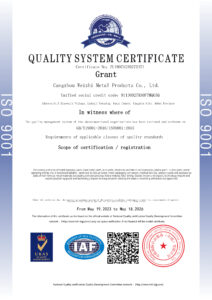 The four checks
- Validity today. Read the expiry date, because an expired certificate still looks convincing in a PDF.
- Scope coverage. Check that the scope words cover the processes you are buying; additionally, note that a certificate covering cutting and stamping may exclude welding, casting or surface treatment.
- Accredited issuer. Confirm the certification body holds accreditation, because an unaccredited certificate is a document rather than a certification.
- Database match. Look the number up in the certification body’s public register or in IAF CertSearch, the IAF-mandated global certificate database, and then confirm the legal entity name matches the company that invoices you.
A documentation trap to watch for
Meanwhile, watch for one common mistake. A Chinese unified social credit code looks nothing like an ISO certificate number. If a supplier’s page or quotation presents an 18-character registration code as an “ISO certificate number”, treat the quality claim as unverified until the real certificate appears. In most cases this signals a documentation error rather than fraud, yet it still means nobody checked the ISO claim internally.
Which red flags point to a trading company?
Watch for the following patterns when you screen a Chinese metal stamping supplier, because three appearing together describe the normal shape of a broker:
- Lead time shifts after you ask about tooling, because the supplier must order tooling elsewhere.
- The equipment list gives ranges such as 80 to 400 tonnes, yet shows no unit counts, machine sizes or photos of specific machines.
- A design change gets answered with “we will ask the factory”.
- The licence address differs from the address you are invited to visit.
- Certification appears as “ISO 9001 quality” or “ISO standard” with no number or issuing body.
- Inspection reports stay generic and never reference a lot or heat number.
What to do if you suspect a trading company
If the signals point toward a broker, do not abandon the conversation — redirect it toward evidence:
- Verify the address on a map. A factory sits in an industrial zone; a broker’s address is often an office building.
- Request a live video walk-through of the specific machines that will make your parts — not a canned tour of the showroom.
- Place a small paid sample order. A factory processes it in-house; a broker forwards it and adds delay.
At Cangzhou Weizhi all of this is standard practice: the video tour is arranged on request, quotes always separate tooling, piece price and MOQ, and samples ship with first-article inspection reports.
What quality records should a factory produce in writing?
Verification does not end with a site visit. Instead, a factory running a documented quality system can produce paperwork that a broker cannot:
- First-article inspection on the first parts of the run, signed, with the drawing revision referenced.
- In-process checks at defined intervals, so batch consistency becomes documented rather than promised.
- CMM reports on features carrying geometric tolerancing; this is why the presence of coordinate measuring machines matters more than the presence of calipers.
- Material certificates matched to the lot or heat number of the material actually consumed.
- An inspection report travelling with each shipment, so your receiving inspection reconciles against the supplier’s own measurements.
If a Chinese metal stamping supplier cannot show a first-article report carrying a drawing revision, the quality conversation has not started.
What can Cangzhou Weizhi document for a verifying buyer?
Cangzhou Weizhi has produced metal parts since 1999 and operates an ISO 9001:2015 certified facility in Cangzhou City, Hebei Province. In addition, the production base covers more than 9,000 m² with daily output above 5,000 pieces.
Live tour, equipment and process chain
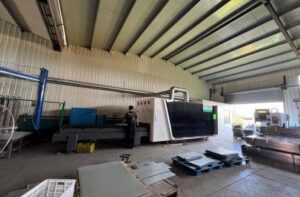
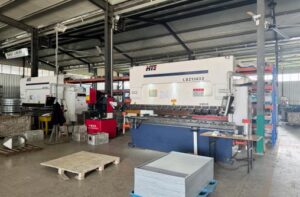
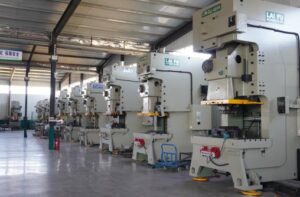
Buyers can request a live video tour of the stamping, laser cutting, bending, welding, CNC and surface treatment areas, including the zone where their project would run. Furthermore, the equipment includes 80–400 tonne stamping presses, 6 kW laser cutting equipment, bending machines, CNC milling and turning centres, and coordinate measuring machines. Because the process chain stays in-house, steps such as stainless steel fabrication do not pass to unknown third parties. Read the equipment list for the current capability figures.
Samples, quotation and track record
Moreover, samples come off production machines under the same process controls as the volume run, so an approved sample matches the parts you later receive. The engineering team reviews your drawing and returns a quotation within 1–2 working days, flagging tolerance, tooling and finishing risks before you commit. Finally, the track record covers more than 70,000 types of metal parts for over 3,000 enterprises across more than 100 countries. Browse the custom parts gallery for representative projects, and read about our factory for the full history. Send a 2D or 3D drawing to this Chinese metal stamping supplier through the quote request page, and the team answers initial questions within 2 hours.
FAQ
How can I tell if a Chinese metal stamping supplier is a real factory?
When you assess a Chinese metal stamping supplier, ask for three things: a business licence whose scope covers metal manufacturing, a live video tour of the running floor, and process proof that ties your part to a specific machine and tooling. Then verify the ISO 9001:2015 certificate in an accreditation database.
Verifying the supplier itself
Does a Chinese business licence prove that a supplier is a factory?
No. A licence proves legal registration, and many trading companies also register a manufacturing scope. Therefore, treat it as a necessary filter rather than proof.
How do I verify that an ISO 9001:2015 certificate is genuine?
Confirm four points: the certificate stays within its validity dates, the scope covers your processes, the issuer holds accreditation, and the number appears in the issuer’s register or IAF CertSearch under the same legal entity that invoices you.
Should the prototype and the mass production run use the same machines?
Yes, for most projects. If different equipment makes the prototype, the approved sample tells you little about the parts you will receive. So ask which machine and which tooling produced it.
Why does an ISO 9001 certificate not guarantee good parts?
Because it certifies a documented quality system rather than dimensional results. Batch consistency instead depends on first-article inspection, in-process checks at defined intervals, and calibration of measuring equipment.
Verifying documents and process records
Which documents should I request before a first order?
Request the business licence, the ISO 9001:2015 certificate with scope wording, the equipment list, a redacted first-article report, a sample CMM report, and two reachable references for similar products. A Chinese metal stamping supplier that runs a documented system produces all six without delay. See why our metal parts stay reliable for how we structure that documentation.
How long should a quotation take from a factory?
A reviewed quotation typically takes 1–2 working days after the drawing arrives, because an engineer reads the geometry before pricing it. An instant price on a complex part usually means nobody reviewed the drawing.
|
Verifying a Supplier? Get the Evidence, Not a Brochure ✅ Free drawing review · ISO 9001:2015 certified · Live video tour, first-article and CMM reports on request
Upload your drawing — request the equipment list, a redacted first-article report and an itemized quote |
📩 Reply within 2 hours · DFM feedback and itemized quote within 24 hours
|
Related Posts
-
Press Brake Springback: Why Bends Overshoot and How Factories Compensate
Press brake springback is elastic recovery: when the brake releases, the part straightens a few ...
-
Deep Drawing Sheet Metal: Draw Ratios, Limits & Multi-Hit Setup
Deep drawing sheet metal is a forming operation: a punch pulls a flat blank into a cup or pan sh ...
-

Sheet Metal Gauge Chart: Thickness, Strength & Cost by Gauge
This sheet metal gauge chart is the reference our press engineers use before quoting. Gauge is a ...