
Metal Material Selection: Mild Steel, Stainless, Aluminum
Material sits at the first line of every fabrication quote — and it hides the biggest silent savings. Metal material selection decides the part’s cost, its behavior on the press brake, its weldability, its corrosion life, and its finish options, before a single cut runs. This guide compares the three families on the dimensions that matter to a buyer. Then it shows how to select by driver instead of by habit.
The Three Families
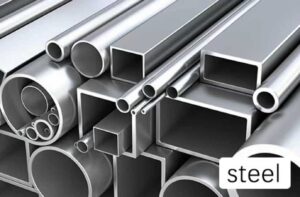
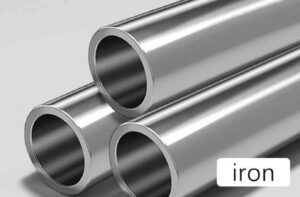
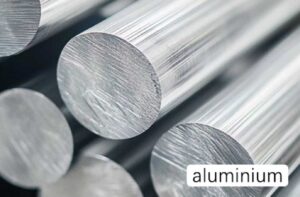
First, know what you are actually choosing between. Carbon (mild) steel leads the catalog: A36 for structural work, 1008/1018 for general fabrication — cheap, strong, easy to weld and paint, but it corrodes unless you protect it. Stainless steel — 304 for general service, 316 where chlorides appear (coastal, chemical, food) — buys corrosion resistance at roughly 2.5–3× the material cost of mild steel. Aluminum — 5052 for formed parts, 6061 for machined parts — buys weight (about one third of steel’s density) and good corrosion resistance, with different forming and finishing behavior. Overall, the three families cover the vast majority of fabricated parts; copper and brass serve specialty electrical and decorative roles.
The Comparison Table
Next, the table below reads the three families across the rows that decide a quote.
However, read the table as a set of trade decisions, not a ranking. No family wins every row. The row that matters for your part is the one your application actually stresses.
A Driver-Based Metal Material Selection Method
Then, metal material selection starts from the driver, not from the catalog. The table below maps the common drivers to the standard answer.
Because drivers conflict — “lightest and cheapest” is not a specification — write the top two on the drawing or in the RFQ (item 2 of our RFQ checklist). So the supplier can challenge a wrong assumption before it becomes a price.
Formability: What the Material Does to the Bend
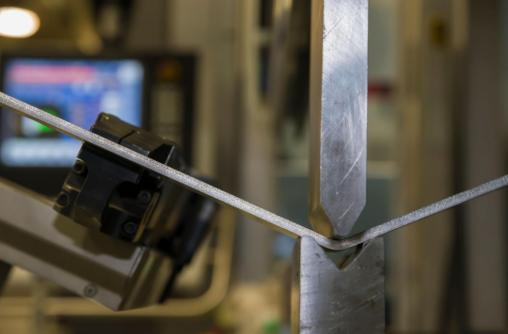
In practice, the material decides the bending behavior, and the bending behavior decides the flat pattern and the bend tolerance. Mild steel forgives: springback runs small and predictable, and a standard inside radius of about 1× thickness bends cleanly. Stainless resists more — it wants a 1.5–2× thickness radius and shows more springback, so the bend table must build for the specific alloy. Aluminum sits between: 5052 forms well but with high springback, and the K-factor shifts with temper — a part that you draw in 5052-H32 behaves differently from 5052-O. Our tolerance and DFM guide carries the K-factor and minimum-radius tables; check the material column first.
Finishing: Matching the Pair
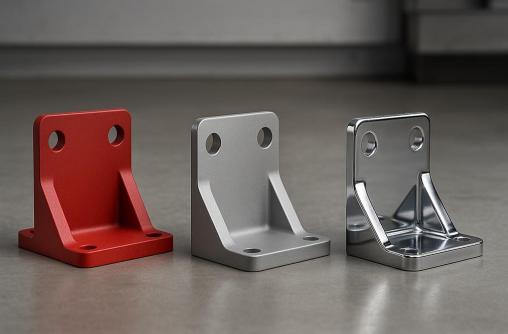
The finish specification follows the material, and a mismatched pair is a common quote error. Mild steel takes powder coat, paint, or hot-dip zinc. Specify the system and the salt-spray hours — 480 h zinc is a common outdoor reference. In practice, stainless almost always stays bare: passivation for corrosion, polishing for appearance. Someone who quotes “painted stainless” probably solves the wrong problem — the part likely needs painted mild steel instead. Aluminum finishes by anodizing (hard-wearing, color options, no peel risk), powder coat, or bare mill finish. So state the environment in the finish line: “outdoor, coastal” means a different system than “indoor, painted.”
Certificates and Traceability
Finally, metal material selection ends only when the paper trail matches it. For stainless and aluminum especially, grade substitution is the classic failure mode — a 304 part that actually came from 201 stock. Two controls catch it. The material certificate (EN 10204 type 3.1, matched to the heat number) covers every critical batch. Also, PMI (positive material identification) verifies the alloy non-destructively. Our ISO 9001 guide shows how a certified shop keeps these records under clauses 8.5.2 (traceability) and 8.6 (release). The first article inspection guide marks where the material check sits in the FAI.
Frequently Asked Questions
What separates 304 from 316 stainless?
Both are austenitic stainless. 316 adds molybdenum, which improves resistance to chlorides — seawater, de-icing salts, chemical environments. For indoor and general outdoor use, 304 is standard; for coastal or chemical exposure, 316 is the safer call. The price gap is meaningful, so specify 316 only where the environment demands it.
Can painted mild steel serve outdoors?
Yes — mild steel plus a proper coating system is the standard outdoor answer. The coating carries the corrosion duty, so specify the system and the performance target (salt-spray hours, expected exposure). Also, stainless and aluminum exist for the maintenance-free outdoor case.
Which corrodes faster — aluminum or stainless?
It depends on the environment. In most air, both outperform uncoated steel. For chloride-rich coastal settings, 316 usually outlasts aluminum, while anodized aluminum performs very well. Under highly alkaline or marine electrolyte conditions, aluminum can suffer — so state the environment and take a written recommendation.
What is A36, and how does it differ from 1018?
Both are common mild steels. A36 serves structural plate and sections — frames, supports. 1008 and 1018 carry the general-fabrication role: cold-rolled sheets with better surface and tighter thickness. For bent and welded sheet parts, cold-rolled 1018-class material is the usual call.
Can I swap 1018 for A36 on my part?
Usually yes for sheet fabrication — the mechanical difference stays small, and both weld well. Confirm with the supplier when the part carries load or a structural code names A36 specifically. Otherwise the swap is a cost-neutral simplification.
How big is the real cost gap between the families?
As a planning baseline, 304 stainless runs about 2.5–3× mild steel material cost. Overall, aluminum runs about 1.5–2.5×, depending on alloy and temper. Downstream effects — bend radius, finish route, weld procedure — add or subtract on top. So itemize the material line on every quote; our cost guide shows the line-by-line read.
|
State the Environment — Get the Grade Back in Writing ✅ Grade recommendation by application · Bend behavior and finish route attached · EN 10204 3.1 certificate plan
Upload your drawing — get the grade, its bend behavior, finish route, and certificate plan before the price locks |
📩 Reply within 2 hours · DFM feedback and itemized quote within 24 hours
|
Related Posts
-
Press Brake Springback: Why Bends Overshoot and How Factories Compensate
Press brake springback is elastic recovery: when the brake releases, the part straightens a few ...
-
Deep Drawing Sheet Metal: Draw Ratios, Limits & Multi-Hit Setup
Deep drawing sheet metal is a forming operation: a punch pulls a flat blank into a cup or pan sh ...
-

Sheet Metal Gauge Chart: Thickness, Strength & Cost by Gauge
This sheet metal gauge chart is the reference our press engineers use before quoting. Gauge is a ...