
Sheet Metal Design Determines Mass Production Success in Metal Fabrication
In metal fabrication projects, a large number of custom metal parts function properly during the sample stage, but exhibit size deviations, unstable assembly, or cost overruns when entering mass production. The primary cause is not usually a lack of equipment capacity, but rather the fact that the sheet metal design fails to clearly define the manufacturing process and tolerance management system at an early stage.
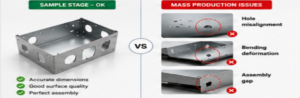
Core point: The essence of sheet metal design is not to merely draw a part, but to define the entire manufacturing process in advance. Every design decision will directly affect the production method (laser cutting,/Stamping forming/bending sequence/welding assembly) as well as the cumulative tolerance logic. A well-designed process enables smooth, efficient production; an unreasonable design continuously amplifies the costs of adjustments and rework.
Manufacturability: Whether the Part Can Be Reliably Produced
The design shown in the drawing does not necessarily mean it can be reliably manufactured. Common design flaws in actual production include: a too-small bending radius causing material cracking; the distance between the hole position and the bending line being too close, weakening structural strength; incorrect layout diagrams affecting the laser cutting path; and local features requiring manual correction.
| Process Type | Typical Applications | Key Design Considerations |
|---|---|---|
| Laser Cutting | Complex contours, low-volume production, flexible processing | Accurate flat pattern development, avoid excessively small inner corners |
| Stamping/Forming | High-volume standardized structures (80–400T) | Feature standardization, die compatibility |
| Bending/Forming | Structural forming, angle control | Bend radius, springback compensation |
If the sheet metal design deviates from the standard process window, non-standard processing will be forced, significantly increasing costs and delivery uncertainty.
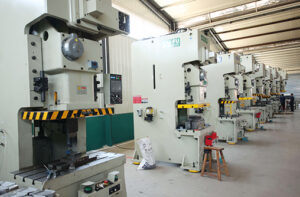
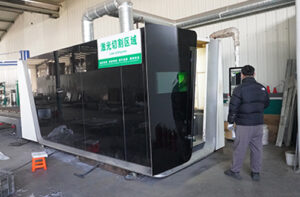
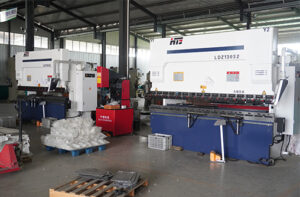
Production Efficiency: How Design Complexity Affects Workflow
Even if the parts can be manufactured in theory, an unreasonable design will increase process complexity and disrupt workflow continuity. Typical manifestations include:
- Excessive bending operations → Extended process chain, accumulation of positioning errors
- Local features cannot be directly formed → Need for secondary drilling or trimming.
- Increased welding and assembly steps → Higher proportion of manual participation, decreased consistency.
When the design deviates from the optimal manufacturing path, the production process shifts from “standardized continuous processing” to “multi-step segmented handling”, directly affecting cycle time and the cost structure.
Sheet Metal Design and Batch Consistency in Mass Production
Batch consistency is the most critical factor in mass production, yet often overlooked at the design stage.
Common issues include:
- accumulated tolerance errors across multiple processes
- inconsistent bending angles due to material springback
- shifting hole positions between production batches
These problems are not caused at production stage, but by lack of tolerance strategy in design.
In industrial manufacturing, dimensional stability is verified through systems such as CMM inspection, but true stability must be built into the design phase, not corrected later.
Engineering System Capability Behind Stable Mass Production
The design structure itself can only be transformed into a sustainable mass production outcome within a manufacturing environment that possesses a stable engineering system. The engineering system’s capabilities are manifested at three levels:
- Stable forming and process execution: The stability of processes such as stamping, bending, and structural forming determines whether the design can be transformed from the drawing into a consistent physical structure;
- Process consistency and quality control: Systematic quality control and dimension inspection mechanisms ensure that the key structures of different batches of parts remain consistent;
- Large-scale delivery and engineering verification: Long-term stable delivery capability, rather than single-time production capacity.
*These long-term production data demonstrate the ability to transform sheet metal design into stable, scalable industrial output.
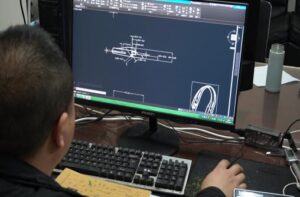
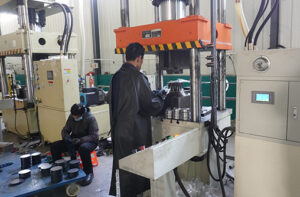
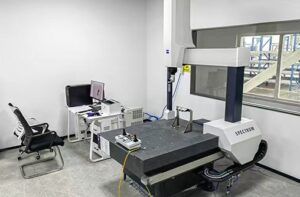
In actual industrial settings, these capabilities collectively demonstrate that a proper sheet metal design can be reliably transformed into a scalable industrial production outcome. During the design review stage, risks associated with mass production can be predicted through process simulation and tolerance analysis.
What Sheet Metal Design Ultimately Determines
In modern metal fabrication, sheet metal design determines three critical outcomes:
- Manufacturability → whether the part can be physically produced
- Production efficiency → whether it can be manufactured at reasonable cost and speed
- Batch consistency → whether it can be reliably repeated in mass production
A well-engineered design enables smooth scaling into mass production. A poorly structured design continuously increases cost, variation, and manufacturing risk.
We provide manufacturability analysis, production optimization, and mass production feasibility support for custom sheet metal parts.
Related Posts
-
Metal Stamping Services: How a Full-Service Supplier Delivers Your Drawings
Metal stamping services are more than pressing sheet metal into a shape. For a buyer, the real s ...
-
ISO 9001 Certified Sheet Metal Fabricators: Does Certification Reduce Your Total Cost?
An ISO 9001 certified sheet metal fabrication manufacturer’s quote is not necessarily the ...
-
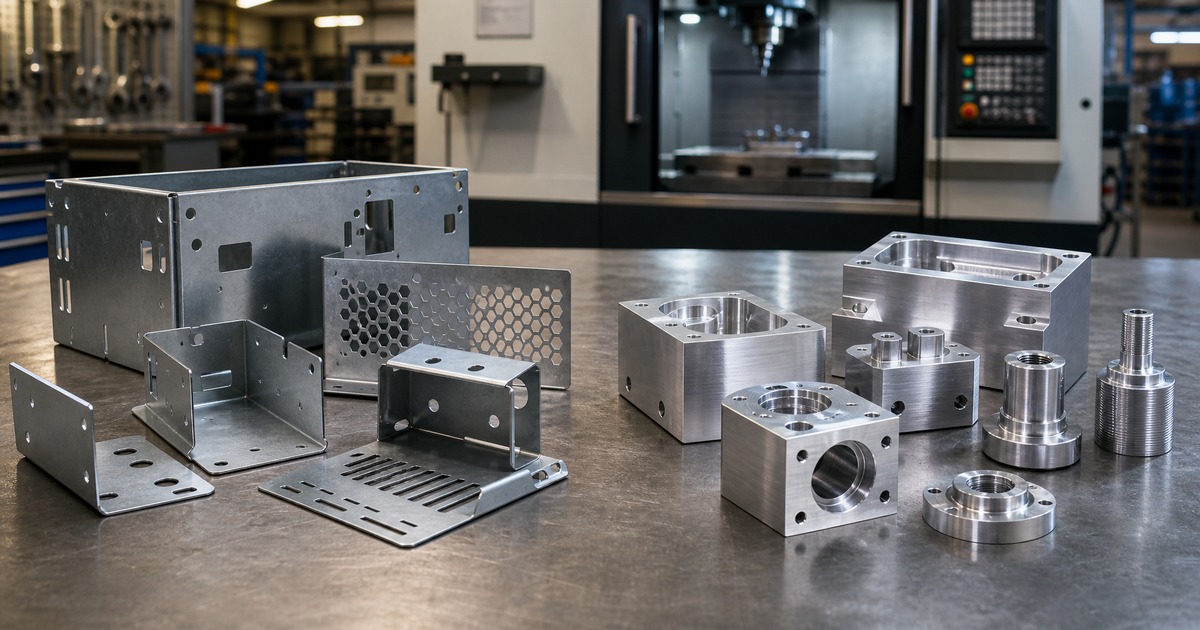
Sheet Metal Fabrication vs CNC Machining: How to Choose
Both processes produce metal parts, but they start from different material forms and add cost at ...