
Design for Manufacturability for Sheet Metal: Why Some Parts Enter Production Faster
In the metal processing industry, DFM for Sheet Metal Fabrication often directly determines whether a part can smoothly enter mass production. The same drawing can result in one product being ready for trial production and entering mass production within a few days, while another may require repeated adjustments, modifications, and even rework in the workshop.
This difference is not entirely due to the factory’s capabilities; it depends more on whether the “how to be manufactured” aspect has been truly considered during the design stage.
In other words, whether a product is easy to manufacture is largely determined during the design stage.
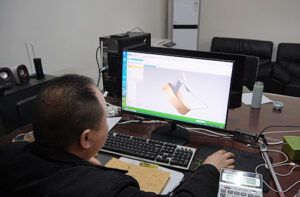
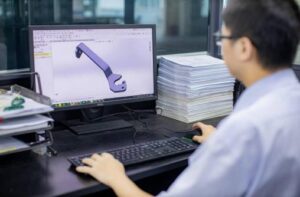
Common DFM for Sheet Metal Fabrication Mistakes in the Design Stage
In actual production, many delays do not occur during the processing stage, but rather are latent problems that were introduced during the design phase, which are then magnified in the workshop.
Common situations include:
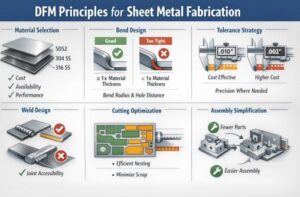
• The bending structure is too tight, without considering the minimum bending radius
• The hole positions are too close to the edges, making them prone to deformation during stamping
• Multiple parts could have been integrated into one piece, but were instead split into welded structures
• Insufficient assembly space, resulting in interference later on
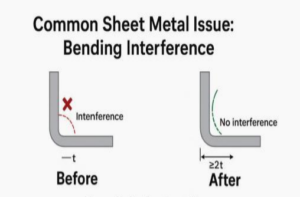
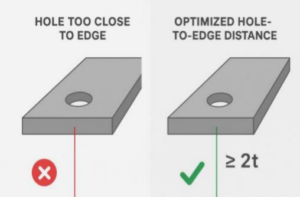
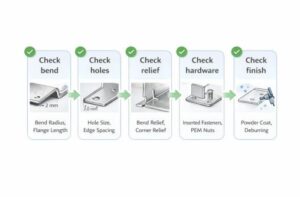
These issues usually “seem fine” at the drawing stage, but once they enter production, they turn into process conflicts.
Many projects are repeatedly revised. In fact, it is not due to insufficient manufacturing capabilities, but because the design did not consider the processing constraints in advance.
How DFM for Sheet Metal Fabrication Improves Stamping and Bending
In sheet metal manufacturing, laser cutting, stamping, and bending form the main shaping processes.
DFM helps ensure the design aligns with the real capabilities of these processes.
A well-optimized design typically includes:
- A clear and interference-free bending sequence
- Bending radii matched with material behavior
- Stamping features designed within forming limits
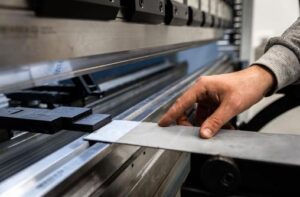
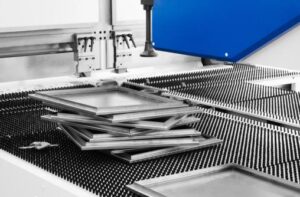
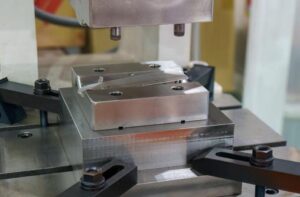
For example, a cabinet side panel without a defined bending sequence may interfere with tooling during the final operation, preventing proper forming and requiring redesign.
From a manufacturing perspective, Design for Manufacturability does not speed up machining itself—it reduces trial-and-error during early production.
How Tolerance Design Affects Sheet Metal Production Efficiency
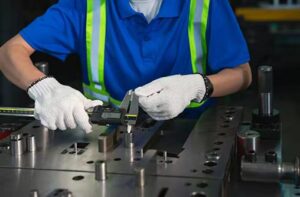
Tolerance definition has a direct impact on production stability, even though it is often underestimated.
In practice, two situations are common:
Some parts do not fail during machining but repeatedly fail during inspection due to overly strict tolerances.
DFM focuses on a simple principle: Let precision serve functionality, rather than pursuing the highest precision everywhere.
How Design Complexity Increases Tooling Time
In mass production, tooling development often defines the overall project timeline, and design complexity is one of the main influencing factors.
Simple structures can often use standard tooling, while complex designs may lead to:
- The tooling design time increases
• The number of prototype tests increases
• Process adjustments are repeated
For instance, a part that involves multiple reverse bends or complex stamping features, even if it can be produced in the end, still requires more verification time.
Design for Manufacturability helps reduce unnecessary complexity early, aligning designs with proven manufacturing capabilities.
Real DFM Case: Reducing Rework in Sheet Metal Production
In a sheet-metal enclosure project, the initial design included multi-segment bending and partial assembly structures.
Although the drawing appeared feasible, trial production revealed several issues:
| After optimization, trial production cycles were reduced significantly, and the part entered stable mass production much faster.
The improvement was not due to equipment changes, but due to better alignment between design and manufacturing logic. |
|
Start Your Sheet Metal Project With DFM Support
- ✓
Upload your CAD files or drawings, and our engineering team will evaluate your design from a manufacturing perspective before production begins. - ✓
We help ensure your parts are ready for efficient, stable, and scalable manufacturing.
Related Posts
-
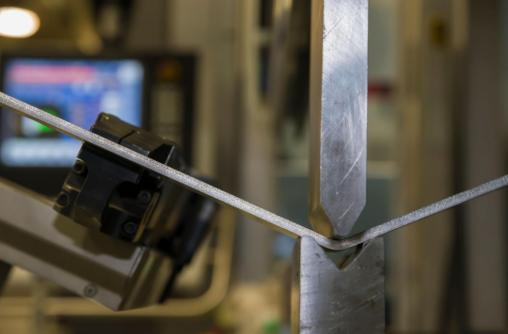
Press Brake Springback: Why Bends Overshoot and How Factories Compensate
Press brake springback is elastic recovery: when the brake releases, the part straightens a few ...
-
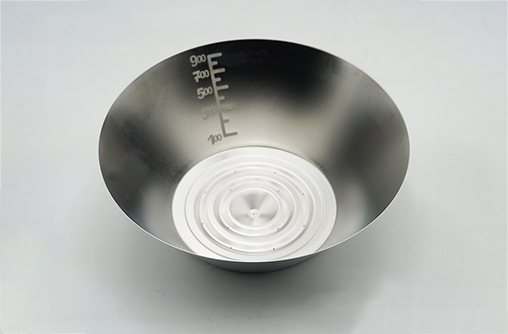
Deep Drawing Sheet Metal: Draw Ratios, Limits & Multi-Hit Setup
Deep drawing sheet metal is a forming operation: a punch pulls a flat blank into a cup or pan sh ...
-

Sheet Metal Gauge Chart: Thickness, Strength & Cost by Gauge
This sheet metal gauge chart is the reference our press engineers use before quoting. Gauge is a ...